Some of the most energetic events in the cosmos are associated with the products left after a star’s violent end. These products are always smaller and denser: a white dwarf (the size of a planet), a Neutron star (the size of a city), or a Black Hole (an object without a size). The bigger the initial mass of a star, the sooner and more energetic its end will be. Our Sun is not all that massive; it will end up as a white dwarf in and out 4.5 billion years from now.
Professor Rene Breton, originally from Quebec, has been working at the Jodrell Bank Centre for Astrophysics for over a decade. We discuss only a small part of his current research, including how Pulsars may one day be used as a GPS for interstellar travel. Other topics include
- Why and how he ended up in Manchester
- His first impressions of Manchester and comparisons with Quebec in Canada
- The key role of a high-school teacher, Mr. Gaudreault, setting him on his career in science
- Stellar evolution – how stars are born and the process by which they end up as white dwarfs, neutron stars and black holes
- Event Horizon Telescope – imaging the black hole in the centre of our galaxy
- The ultimate fate of our Sun
- Quasars are distant galaxies with a Black Hole in the centre, so distant that they look like stars.
- FAST Radio bursts, including Gamma Ray Bursts (GRBs), are from extragalactic distances. Events that last a few seconds or less – a sign of merging neutron stars or evidence of Hypernovae (not novae or supernovae)!
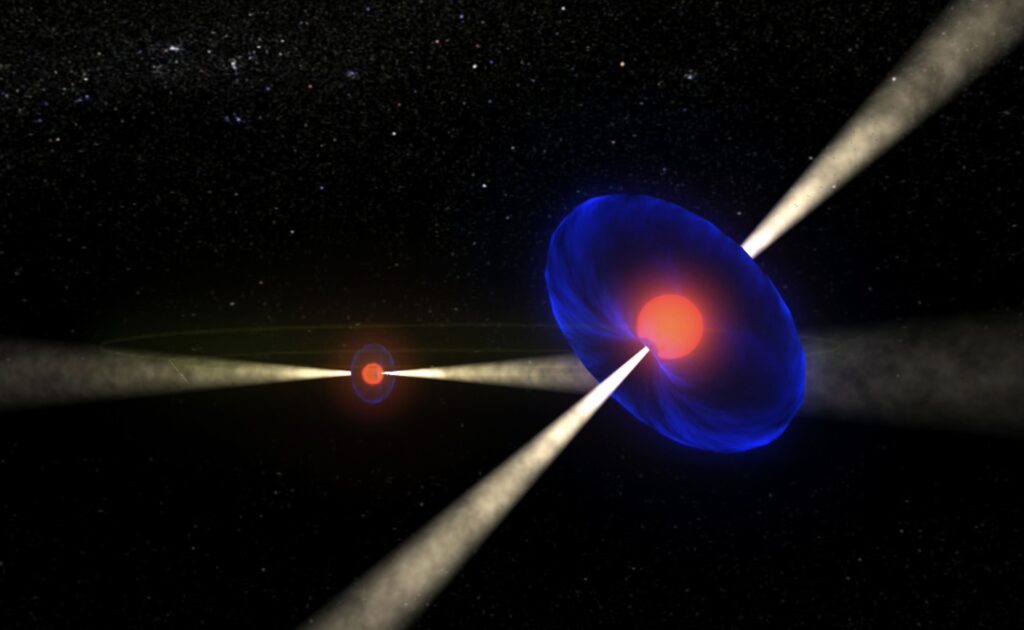
- Neutron Stars in Binary Systems, accretion discs and “spiders”
- Neutron Stars as a cosmic GPS for future space travellers
- Detect Gravitational Waves using neutron stars. Gravitational Wave detectors are not very sensitive, so they can only detect high-energy events, such as the collision of two neutron stars or the formation of black holes.
- Space-borne Gravity Wave detectors, such as the Laser Interferometer Space Antenna, which NASA plans to launch in the 2030s, will be able to detect a wider range of cosmological phenomena.
- Square Kilometer Array’s role in detecting more neutron stars, pulsars and even pulsars orbiting black holes
- Pulsar Timing Array – a GPS for interstellar travel
Podcast: Play in new window | Download (Duration: 1:13:54 — 135.3MB) | Embed
Subscribe: Apple Podcasts | Spotify | RSS | More