AstrotalkUK

Not for profit podcast. Astronomy, Deep Space Exploration and International Collaboration

  • Home
    • FAQ
    • Contact
    • About
    • Privacy Policy
  • Content
    • Podcast
    • All episodes
    • Book Review
    • Cyber Security
  • Events

The Red Rockets’ Glare – Book Review

By Gurbir Dated: October 5, 2012 Leave a Comment

The Red Rockets’ Glare : Spaceflight and the Soviet Imagination, 1857–1957

Title: The Red Rockets’ Glare : Spaceflight and the Soviet Imagination, 1857–1957
Publisher: Cambridge University Press
Author: Asif A. Siddiqi
ISBN: 9780521897600
Price: £58.00 [414 pages hardcover]

This is probably the most meticulous analysis of the culture of an insecure, troubled and courageous people: the Soviets and those that preceded them, who collectively pulled off one of the 20th century’s most spectacular achievements – the launch of Sputnik in October 1957.

The book re-examines and challenges the popular perception of the two almost revered individuals responsible for what came to be known as the Soviet space program: Konstantin Tsiolkovsky, who laid down the initial theoretical framework for space travel, and Sergei Korolev, the persecuted selfless chief designer, who put it into practice.
Starting with events from 1857 and culminating a century later with the launch of Sputnik, the fluent Russian speaking author, using primary sources many being examined by Western eyes for the first time, identifies the complex interplay between the pursuit of space technology and the potential of that technology as an instrument for social and industrial change.

Just as it is impossible in the history of science to untangle astronomy from astrology or chemistry from alchemy, the author establishes the deep connections between the Cosmist Movement and the thread of imagination running through the Soviet people and those that preceded them. The author connects the almost mystical role of Nikolai Fyodorov the founder of the Cosmist Movement in stirring the imagination of a people to believe in the reality of a future beyond that on Earth.

The book reminds us that the Soviet’s launched their first liquid fuel rocket on 25th November 1933 seven years after America and two after Germany. It was in no way inevitable that the Soviets should have been the first nation to travel into space.

The 1917 the Russian revolution was slap bang in the middle of the period examined by the author (1857-1957). Initially ostracised and abandoned because he had done most of his ground breaking work during the Tsarist period, Tsiolkovsky was eventually recognised for his achievements by the Bolsheviks just before his death in 1935. Stimulated by the initial stages of the Cold War in the immediate aftermath of the Second World War, the nationalist movement “Zhdonvschchina” forcibly connected science with national identity and helped secure enormous resources required for the Soviet atomic bomb program, but also helped establish many of the closed government processes and secret industrial complexes that would be necessary for the space program.

Tsiolkovsky’s Russianness was used shamelessly to promote Soviet society through space exploration. The Soviet Academy of Sciences eventually recognised his contribution by publishing his memoirs in 1951. His writings on Cosmism were systematically suppressed but those on space travel re-spun to motivate public opinion and influence state policy. The author establishes how Tsiolkovsky’s name was exploited to manipulate the emotions of the Soviet people and motivated the Soviet government to commit resources to assert Soviet dominance in space. So powerful is that connection that it is unlikely there would have been Sputnik had Tsiolkovsky not been Russian.

The book is full of minute but fascinating detail, and despite the overly academic style remains surprisingly easy to read. For example the origin of the word “cosmonautics” was first introduced by the French educated Ary Sternfeld, who settled in Moscow after a trip to meet with Tsiolkovsky. In the wealth of documents declassified in the post Soviet era, one from 1937-8, “Stalin’s Execution List” records 44,000 individuals of which around 90% were executed. Sergei Korolev was on that list, one in the 10% that was mysteriously spared.

Exploiting the media to engineer public opinion in support of space travel was not a post Sputnik phenomenon initiated in America. On 16th April 1955 Mikhail Tikhonravov (who had originally proposed Sputnik) and Korolev published a piece in a local paper Evening Moscow to stimulate local (Soviet) interest in space exploration. But an unexpected response in the New York Times fired the starting pistol that would lead eventually to what became the Space Race. This was the seed that blossomed into the Soviet/US epic rivalry that would be so evident during the Apollo era and ultimately was responsible not only for mankind’s first landing on the Moon but also for achieving that astonishing feat with such incredible haste.

A surprising omission from this book is the work of Nikolai Kibalchich. Frequently overlooked in the West and another opportunity lost here. In his far-sighted contribution under extraordinary personal circumstances in 1881, Kibalchich proposed a design for rocket propulsion two decades before the Wright Brothers demonstrated powered flight.

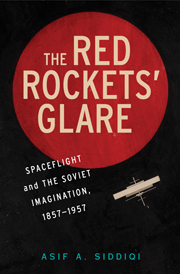
Juxtaposed to the richness of the content, the cover illustration is remarkably unexciting. I found no artistic merit in it but that probably says something more about my artistic sensibilities. Apparently, the cover is a valued piece of art work on display in a museum. This serves as a fortunate reminder of the old maxim that you shouldn’t judge a book by its cover.

The book is written and designed for the academic environment but it has much to offer those who are curious about the origins of the Soviet space program. The publishers ought to consider releasing an eBook and/or a paperback copy with fewer references and a significant price cut and thus bring this fascinating content to the attention of many of those who would appreciate the rich detail of a beguiling episode in human endeavour.

Share this:

  • Share on LinkedIn (Opens in new window) LinkedIn
  • Share on Facebook (Opens in new window) Facebook
  • Share on Bluesky (Opens in new window) Bluesky

Episode 54: 23 July 2012 – Manchester Interplanetary Society and Stanley Davis

By Gurbir Dated: July 23, 2012 1 Comment

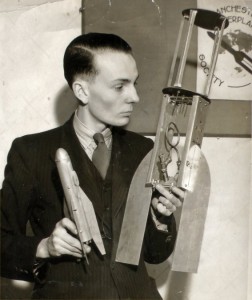
Stanley Davis

The August 2012 edition of Spaceflight, the monthly magazine of the British Interplanetary Society, carried an article in which I discuss the Northwest of England’s contribution to Rocketry during the 1930s. An extended version of that article is available for free download on Astrotalkuk.org – here.

So on to today’s episode.

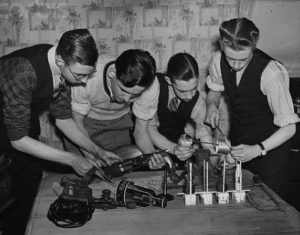
In 1937, two teenagers, Harry and Stanley, with an outrageous ambition to design and build rockets for space travel, joined a newly formed group with a name to match – the Manchester Interplanetary Society. Soon, each met a girl, fell in love, exchanged wedding rings and got married. They went off on their separate ways but pledged to stay in touch. In addition to his interest in rockets, he was also strongly interested in science. In the late 1930, he went by train to London to hear a talk from H.G. Wells. Had he not died prematurely, he, like Harry, would have immersed himself in the sci-fi fandom movement that was blossoming in Britain from the early 1930s.

Wooden Statue of Abraham Lincoln. Carved by Stanley Davis
Members of the Manchester Interplanetary Society. Harry Turner is 1st on the left

Two years later, the ferocious and violent events of World War II began that would shatter their dreams and lives, along with those of millions of others around the world. Harry Turner spent much of the War in India and, following his return, enjoyed a successful career as an artist. Stanley Davies died in August 1941 from injuries he had sustained at Dunkirk.

Recently, this shared story brought together Harry’s son, Philip, and Stanley’s daughter, Ann.  In episode 50, Philip recalls his father’s memories, and in this episode, Ann Sutcliffe remembers her father, Stanley Davies.

https://media.blubrry.com/astrotalkuk_podcast_feed/astrotalkuk.org/wp-content/uploads/episode54.mp3

Podcast: Play in new window | Download (Duration: 7:11 — 6.6MB) | Embed

Subscribe: Apple Podcasts | Spotify | RSS | More

Share this:

  • Share on LinkedIn (Opens in new window) LinkedIn
  • Share on Facebook (Opens in new window) Facebook
  • Share on Bluesky (Opens in new window) Bluesky

Episode 53: 28th June 2012 – The Chinese Space program

By Gurbir Dated: June 28, 2012 Leave a Comment

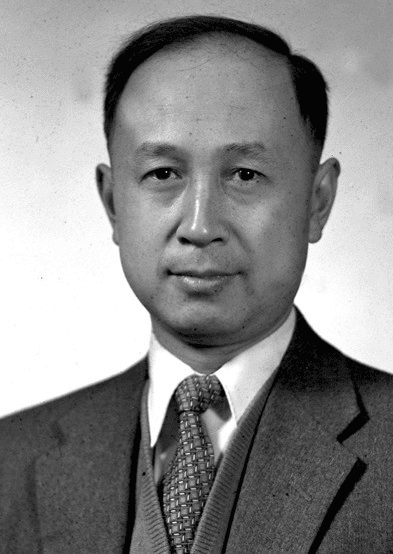
Qian Xuesen

Even a cursory look at the Chinese spacecraft design indicates a close, obvious connection between Chinese and Soviet space technology. No doubt a result of the close geography and a shared political ideology during the Soviet era.

In this episode, a space historian specialising in the Chinese and Soviet/Russian space programs outlines the history, current status, and future of Chinese space activities.

Brian Harvey is a Dublin-based writer, author, broadcaster and probably the most informed specialist on the Chinese space program in Ireland today. This conversation was recorded during the Shenzhou-9/Tiangong-1 mission, which orbited Earth with three crew members, including the first Chinese female astronaut, onboard. At the end of the interview, Brian talks about the Space Cooperation Memorandum signed last week.

This telephone interview was recorded on Tuesday, 26th June, and published today, one day before the scheduled return of Shenzhou-9.

https://media.blubrry.com/astrotalkuk_podcast_feed/astrotalkuk.org/wp-content/uploads/episode53.mp3

Podcast: Play in new window | Download (Duration: 34:06 — 31.2MB) | Embed

Subscribe: Apple Podcasts | Spotify | RSS | More

Share this:

  • Share on LinkedIn (Opens in new window) LinkedIn
  • Share on Facebook (Opens in new window) Facebook
  • Share on Bluesky (Opens in new window) Bluesky

Shenzhou-9 Launched!

By Gurbir Dated: June 16, 2012 1 Comment

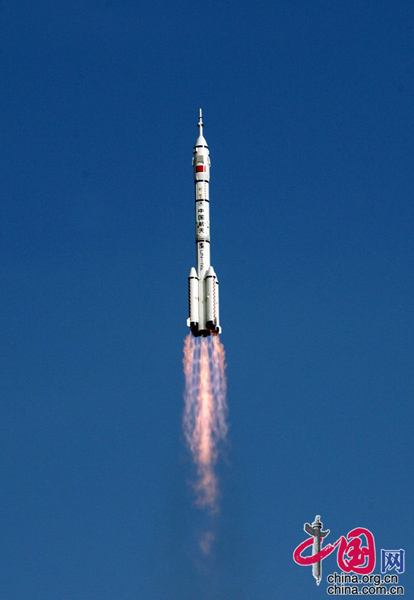
Today’s Shenzou-9 made a text book launch atop the Long March 2F  rocket from the northern Gansu province based Jiuquan Satellite Launch Centre in China.  Following the Soviet era like secrecy on launch date and identity of the crew, the actual launch was covered live by CCTV including feeds from the launch centre, control centre in Beijing and live images of the crew from inside the spacecraft.  Remarkably open live coverage continued from before ignition, during launch including stage separation up to solar array deployment. China looks confident and seems to wants to demonstrate that it knows what it is doing.
In an almost nonchalant approach to launch at T- 30 minutes prior to evacuate the launch site, the departing engineers lined up in front of the launch tower for pictures. The whole thing was tinged with an unusual aura of routine rather than the historic event in space history.

Launch itself did not generate the large quantity of dark smoke common with NASA Atlas and space shuttle. Perhaps because the booster rockets used liquid not solid fuels. The crew looked sombre and did not communicate much with each other or mission control. They hardly smiled preoccupied instead by their manuals in hand. Military presence was always there. Crew saluting at launch, capcom shouting orders and the first congratulatory message was announced by a senior official in military garb.

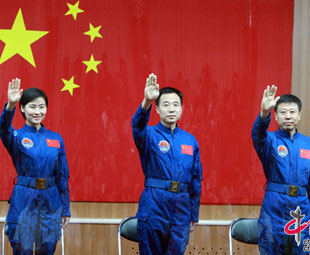
Shenzhou-9 crew Liu Yan, Jing Haipeng & Liu Wang

Before docking with Tiangong-1 the space station launched in September last year, the crew will have to endure the living quarters not much larger than that of the command module of the Apollo era. But then they were all men. The Shenzhou-9 crew, confirmed only yesterday,  consists of crew three astronauts, female Liu Yan and two males Jing Haipeng & Liu Wang.  There is speculation that Liu Yan will undertake a spacewalk during this mission. Today’s launch coincides with the 49th anniversary of the launch of Vostok 6 with cosmonaut Valentina Tereshkova.

Shenzhou-9 will make 5 orbital manoeuvres before an automatic docking with Tiangong-1  on Monday June 18th. It will remain docked for 8 days. Following another but manual docking manoeuvre, the crew will return after 11 days in space.

Share this:

  • Share on LinkedIn (Opens in new window) LinkedIn
  • Share on Facebook (Opens in new window) Facebook
  • Share on Bluesky (Opens in new window) Bluesky
« Previous Page
Next Page »

Find me online here

  • E-mail
  • Facebook
  • LinkedIn
  • Twitter
  • Vimeo
  • YouTube

subscribe to mailing list and newsletter

  • This field is for validation purposes and should be left unchanged.

Browse by category

Recent Comments

  • Frank Pleszak on Episode 117: Early Aviation in Manchester
  • Gurbir Singh on Episode 111: Chandrayaan-3
  • Lunar Polar Exploration Mission: Difference between revisions – भोजपुरी on Episode 82: Jaxa and International Collaboration with Professor Fujimoto Masaki
  • Gurbir on Public Event. Anglo Indian Stephen Smith – India’s forgotten Rocketeer
  • Sandip Kumar Chakrabarti on Public Event. Anglo Indian Stephen Smith – India’s forgotten Rocketeer

Archives

Select posts by topic

apollo astrobiology Astrophotography BIS Book Review Carl Sagan CCD China chines space Cloud Computing cnsa commercial Cosmology curiosity Education ESA Gagarin History India Infosec ISRO jaxa Jodrell Bank Mars Media Moon NASA podcast radio astronomy Rakesh Sharma rocket Rockets Roscosmos Science Science Fiction seti Solar System soviet space space spaceflight titan USSR video Vostok Yuri Gagarin

Copyright © 2008–2026 Gurbir Singh - AstrotalkUK Publications Log in