AstrotalkUK

Not for profit podcast. Astronomy, Deep Space Exploration and International Collaboration

  • Home
    • FAQ
    • Contact
    • About
    • Privacy Policy
  • Content
    • Podcast
    • All episodes
    • Book Review
    • Cyber Security
  • Events

Chinese Soviet Forum:British Interplanetary Society – London 9th June 2012

By Gurbir Dated: June 13, 2012 Leave a Comment

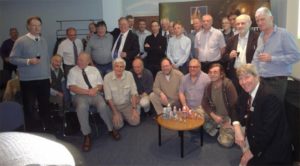
Chinese Soviet Forum - British Interplanetary Society. London 9th July 2012. Photo - Alistair Scott

I attended the BIS Chinese Soviet Forum lat weekend, organised by Dave Shayler and Bert Vis. With 12 (yes -12!) speakers it was a cram packed day with each speaker’s talk full of meticulous detail in a topic in which they were thoroughly experienced. Throughout the day, amongst their other duties, Steve Salmon, Suzann Parry, Mary Todd and Alistair Scott ensured all attendees had lots to eat and drink. Alan Marlow from Delta Vee recorded the whole day. Thanks to all who signed the petition to bring the Gagarin statue from London to Manchester.

There was so much content throughout the day it is impossible to to include it all in a single blog post. Here is a flavour.
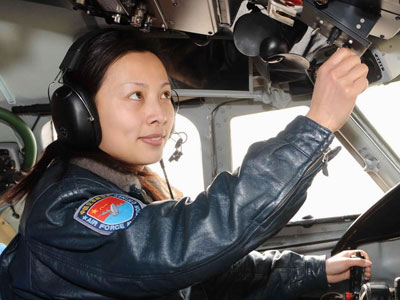
Major Wang Yaping

Pat Norris (who received an Apollo Individual Achievement Award from Neil Armstrong in August 1969 whilst working at NASA)  provided an expert analysis of an official paper published by the Chinese authorities in 2011. The paper discusses the Chinese achievements in the previous five years and outlines the plan for the next five.

Brian Harvey, who has written several books and is working on another about the Chinese space program, provided a summary of China’s space program from origins to the present. Tony Quine, an active space sleuth, explained how he uncovers the details the Chinese authorities do not like to publish.  He predicted that the first Chinese female astronaut will be Major Wang Yaping.

William Carey and Jacqueline Myrrh highlighted a not for profit website specialising in news about the Chinese space program called http://go-taikonauts.com/en/.

Bart Hendrickx provided a fascinating insight into the NK-33 engines from the early Soviet era which may come into active use once more. George Spiteri reminisced by replaying actual recordings from short wave radio broadcasts clips of the Soviet Space era. At a time before the internet that was the only way to get to this type of information.
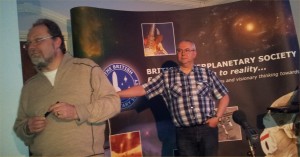
David Shayler and Bert Vis

Bert Vis provided an update about the Yuri Gagarin Space Centre that he has frequently visited and where he will be going again this summer. David Shayler, spoke about the Russian ISS segment in so much detail, you would think he has been there!

Two topics that were pretty much new to me. Fritz Muse introduced Soviet RORSATS and Richard Williams provided a rich illustration of early Soviet philatelic items.

Dominic Phelan spoke about a new book he is editing. It is  not available until 2013 but just looking at the contributors – this should be compulsive reading.

  • Springer Praxis Books, June 30, 2013
  • Softcover, 300 p. 50 illus.
  • ISBN 978-1-4614-3051-3
  • http://www.amazon.co.uk/Cold-War-Space-Sleuths-Exploration/dp/1461430518
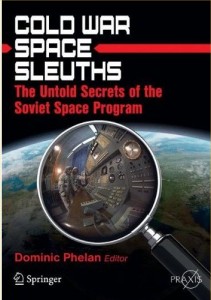
Cold War Space Sleuths: The Untold Secrets of the Soviet Space Program

Cold War Space Sleuths: The Untold Secrets of the Soviet Space Program
Edited by Dominic Phelan.

  • Editor Dominic Phelan, giving an overall history of the Cold War hunt for Soviet space secrets.
  • Space writer Brian Harvey reveals his own personal search through official Soviet radio and magazines to find out what they were (and weren’t) revealing to the outside world at the height of the space race.
  • Robert Christy gives a firsthand account of the famed Kettering Group.
  • Sven Grahn from Sweden details his own 40 year quest to understand what was happening on the other side of the Iron Curtain.
  • Professional American historian Asif Siddiqi explores his own adventures in the once secret Russian archives – often seeing documents never before read by Westerners.
  • Dutch cosmonaut researcher Bert Vis provides an inside account of the Yuri Gagarin training center in Moscow.
  • Belgian researcher Bart Hendrickx’s details his important translation of the 1960s’ diaries of cosmonaut team leader General Kamanin.
  • Pioneer space sleuth James Oberg’s shares his memories of his own notable ‘scoops’ – including revelations about missing cosmonauts, the Nedelin rocket explosion and his trips to previously secret facilities after the fall of the USSR.
  • Paris-based writer Christian Lardier recounts the efforts of French space sleuths – whose work was frequently overlooked in the USA and Britain because of the language barrier.
  • As “one of the original” space sleuths, UK’s David Shayler will write about his experience of recording the Soviet programme in the 1970s and 1980s .
 

Share this:

  • Share on LinkedIn (Opens in new window) LinkedIn
  • Share on Facebook (Opens in new window) Facebook
  • Share on Bluesky (Opens in new window) Bluesky

Remembering the Manchester Interplanetary Society

By Gurbir Dated: May 15, 2012 1 Comment

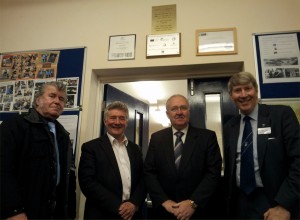
From L to R - Tony Cross, Tony Llyod MP, Frank O'Rourke and Alistair Scott

A plaque was unveiled by the Right Hon. Tony Lloyd MP in front of a packed room at the Clayton Vale Visitors centre yesterday. President Elect Alistair Scott from the British Interplanetary Society traveled up to Manchester to participate in this unique event to celebrate the contribution in rocket development made by the Manchester Interplanetary Society, 75 years ago.

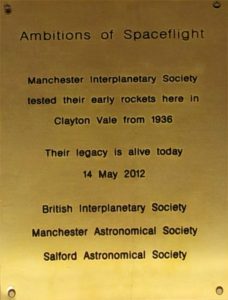
Plaque unveiled by Tony Lloyd MP 14 May 2012

Kevin Kilburn spoke about the MIS’s founder, Eric Burgess who he last met in 1978. Burgess left the UK for the US in 1956 and was based there until his death in 2005. Other guests included Colin Rowe – a real life rocket scientist and Philip Turner, son of MIS member Harry Turner. Dave and Leslie Wright traveled up from Liverpool and members of Salford and Manchester Astronomical Society also attended.

Earlier in the week, I had spoken to Eric Burgess’ daughter Janis who continues to live in California. She was delighted that this event was taking place and shared the following words about her farther.

Eric Burgess was a great scientific thinker and philosopher with ideas that were ahead of his time. He was a many faceted man with a great variety of interests and hobbies.

As I continue to learn more about Eric Burgess, I am increasingly aware that he was of a man of gentle quiet nature and may not have received proper recognition for all his achievements.

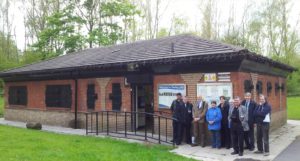
Clayton Vale Visitors' Centre

Thanks to all who came and made this a memorable event especially the hospitality and assistance of Friends of Clayton Vale.  The plaque is located inside the visitors’ centre which is not open on a daily basis. More details about the Clayton Vale Visitor’s Centre via their website www.friendsofclaytonvale.org.uk

Share this:

  • Share on LinkedIn (Opens in new window) LinkedIn
  • Share on Facebook (Opens in new window) Facebook
  • Share on Bluesky (Opens in new window) Bluesky

A public event to commemorate Manchester’s first rocket pioneers

By Gurbir Dated: May 9, 2012 Leave a Comment

Manchester has a world renowned international airport, and if had a group of rocket engineers had had their way, could Manchester have had a spaceport to launch rockets, too?

A group of rocket engineers lead by Eric Burgess formed the Manchester Interplanetary Society in 1936. Working closely with the Sci Fi community, their headquarters were initially on Ashton New Road before moving to member  Harry Turner’s house near Plymouth Grove where the young Arthur C Clarke attended meetings.   Their ambitious choice in naming their society was reflected in the name of their bi-monthly publication – “The Astronaut” published a quarter of a century before Yuri Gagarin made the first flight in to space. It was probably the first time the word “Astronaut” and the idea of human spaceflight entered the Mancunian vernacular.

A brass plaque will be unveiled to a commemorate the Manchester Interplanetary Society on the original site they used to test launch rockets they designed and constructed seventy five years ago. If you would like to attend, download this ms word summary which includes a map.

When: 15:00 – 15:30 Monday 14th May 2012

Where: Clayton Vale, near the city of Manchester stadium.  Download leaflet. Postcode of the nearby Bay Horse Public House is M40 1GR.

Refreshments: will be available for small charge. Limited free parking.

Who is invited: Local astronomers, writers in science and sci fi, press, local politicians, members of the local community and members of Salford Astronomical Society & Manchester Astronomical Society and anyone with an interests in history of spaceflight.

Clayton Vale, a stone’s throw from the velodrome in East Manchester, is now a small picturesque park with the river Medlock running through its length.  In 1936 and 1937 it was undeveloped and used by the MIS members as launch site to test rockets they designed and built.  Their achievements were limited by the prevailing legislation which forced them to use inherently inefficient, solid rocket fuel. Their contemporary rocketry groups in Germany, the Soviet Union and the USA experienced huge success by using liquid fuels.

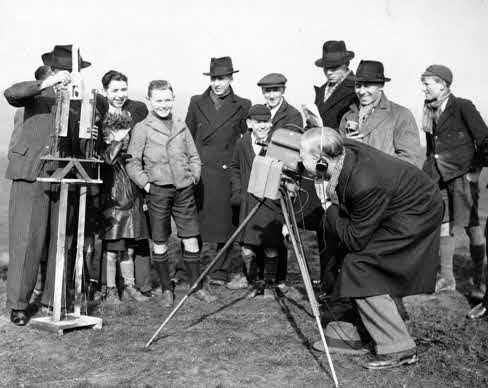
Clayton Vale March 1937 - The cine film was shown at local cinemas over the following weeks

On 14th May 1937, the key member of the MIS found themselves in court accused of making explosives. Explaining that they were testing propulsion techniques for rocket engines, the judge dismissed the case. About the same time, Philip Cleator, who had founded the British Interplanetary Society in Liverpool in 1933, lobbied the government to repeal the 1875 Explosives Act, without success.

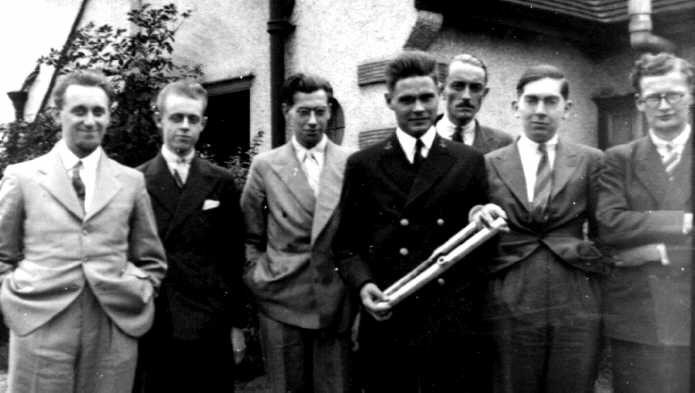
At the Chingford home of R.A.Smith (then HQ of the British Interplanetary Society) on Sunday 17 July 1938 L to R: J.H. Edwards, Eric Burgess, Harry Turner, Guest of Honour Midshipman Robert C. Truax, USN, holding an experimental liquid-fuel rocket motor, R.A. Smith, Maurice Hanson & Arthur C. Clarke. Source: http://www.htspweb.co.uk/fandf/romart/het/footnotes/fanpix/bis1938.jpg

Eric Burgess wrote many books including one of the earliest dedicated to rocket propulsion. In one, Satellites and Spaceflight published in early 1957, he  published images taken with the 8” telescope currently used by the members of the Manchester Astronomical Society, which he had joined in 1936. He also published images of the Moon taken by the 18” telescope now in the observatory at Salford Astronomical Society but at the time located at Jodrell Bank.

Today Astronomical Societies in Manchester, Salford, Didsbury, Altrincham, Bolton, Heaton Park, Altrincham and others continue to inspire the northwest to look up and dream. Arthur C Clarke achieved international success for his science fiction and non-fiction. He wrote both in equal measure. In the 1950s, he permanently moved to Ceylon – today Sri Lanka.   About the same time Eric Burgess emigrated to America and worked for NASA and the space industry.

The inscription on the plaque reads

Ambitions of Spaceflight


Manchester Interplanetary Society

tested their early rockets here in Clayton Vale from 1936

Their legacy is alive today

14 May 2012

British Interplanetary Society

Manchester Astronomical Society

Salford Astronomical Society

The outbreak of World War two brought dramatic developments in rocket technology around the world and to the fortunes of the members of the MIS. In early 1945 as the war approached its end, Burgess, Clarke and others rapidly consolidated the disparate rocket societies around the UK in to a single unified organisation – The British Interplanetary Society – which continues to flourish to this day.

Share this:

  • Share on LinkedIn (Opens in new window) LinkedIn
  • Share on Facebook (Opens in new window) Facebook
  • Share on Bluesky (Opens in new window) Bluesky

Episode 50: 26th March 2012: Manchester first Rocket Scientists

By Gurbir Dated: March 27, 2012 1 Comment

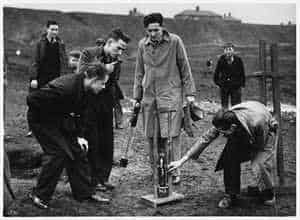
27th March 1937 - Foreground (left to right): Eric Burgess, Bill Heeley, Trevor Cusack, Harry Turner (Picture – Philip Turner)

Robert Goddard in America , Sergei Korolev in the Soviet Union and Herman Oberth in Germany are three names credit with the development of rocket propulsion during the late 1920s and early 1930s. Each led a very small group with more dedication then resources working on a shoestring budget usually in their own time after work. Their collective work eventually lead to Sputnik, the space race and one of mankind’s greatest technological achievement – Apollo 11 mission to the Moon in 1969.

During the inter war years, the northwest of England gave rise to organisations that nurtured the science of rockets and space travel. In 1933, Philip Cleater in Liverpool founded the British Interplanetary Society (BIS) to promote spaceflight, an institution which continues to exist to this day. A little known group established in 1936, called the Manchester Interplanetary Society (MIS) shared the lofty idea of space travel and had the ambition and talent to design, build and test rockets that could help to realise it.

The MIS founded by an ambitious and gifted sixteen year old Mancunian Eric Burgess in 1936.  Initially, Burgess used his own home, 683 Aston New Road as the headquarters but  moved to a founder member, Harry Turner’s house in Lonsdale Place not far Manchester City centre in the following year. Arthur C Clarke a member of both the science and sci-fi communities visited Harry in Manchester several times and promoted both.

Clayton Vale, a stone’s throw from the velodrome in East Manchester, is now a small picturesque park with the river Medlock running through its length.  On Saturday 27th March 1937 it was more of a slag heap for the nearby coal mine and local industry and a site used by the Manchester Interplanetary Society (MIS) to test launch rockets made by its members. Following five largely unsuccessful cardboard rocket launch attempts the sixth constructed from aluminium exploded injuring three, one requiring hospital attention.  The event was heavily featured in local and national press. Malcolm Wade, the MIS secretary said in the 29th March 1937 edition of the Daily Herald “If only the crowds had remained at a proper distance during Saturday’s trials instead of hustling around us, there would have been no accident.”

Most of the active members of the MIS received a summons to appear at the City Police Court on May 14. The charge against Harry Turner was that he “unlawfully did manufacture a certain explosive you not being allowed by section 4 and 39 of the Explosives Act, 1875 to do so“. Harry like most of the members was not eighteen so his father Henry is also named on the summons.  In the event, Eric Burgess successfully argued that they were not manufacturing explosives but conducting rocket propulsion experiments.  No one was found guilty. They agreed not to use Clayton Vale but another site in Glossop instead.

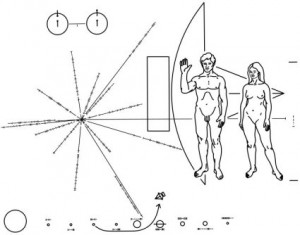
Pioneer 10 Plaque - the original idea from Eric Burgess

After the war Eric Burgess emigrated to America and worked for NASA and the space industry. He wrote many books including one of the earliest dedicated to rocket propulsion.

Perhaps Burgess’s most remarkable achievement is the least well known. Over dinner in November 1971 with Carl Sagan Burgess proposed that a message from humanity should accompany the Pioneer 10 destined for Jupiter in the following spring. Pioneer 10 would be the first man-made object to achieve solar system escape velocity and head in to interstellar space.  The plaque was designed by Carl Sagan and Frank Drake and successfully incorporated in to the mission in a very short time.  Although Burgess was informed about the plaque prior to launch, the image of a naked man and woman was so controversial in the 1970’s conservative America that NASA insisted on a news embargo until after launch.

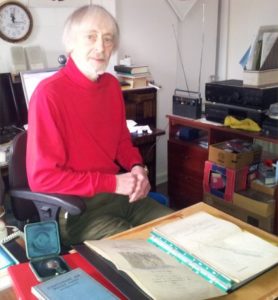
Philip Turner

A plaque on display at the Smithsonian Institute in America recognises Eric Burgess’s contribution to space travel. In Manchester there is nothing to mark the unique achievements of Eric Burgess, Harry Turner, Malcolm Wade and others who were Manchester’s very first rocket scientists.

In this interview Philip Turner’s son, Philip talks about Harry but fist, Harry’s widow Marion on how she first met Harry.


https://media.blubrry.com/astrotalkuk_podcast_feed/astrotalkuk.org/wp-content/uploads/episode50.mp3

Podcast: Play in new window | Download (12.9MB) | Embed

Subscribe: Apple Podcasts | Spotify | RSS | More


Share this:

  • Share on LinkedIn (Opens in new window) LinkedIn
  • Share on Facebook (Opens in new window) Facebook
  • Share on Bluesky (Opens in new window) Bluesky
« Previous Page
Next Page »

Find me online here

  • E-mail
  • Facebook
  • LinkedIn
  • Twitter
  • Vimeo
  • YouTube

subscribe to mailing list and newsletter

  • This field is for validation purposes and should be left unchanged.

Browse by category

Recent Comments

  • Frank Pleszak on Episode 117: Early Aviation in Manchester
  • Gurbir Singh on Episode 111: Chandrayaan-3
  • Lunar Polar Exploration Mission: Difference between revisions – भोजपुरी on Episode 82: Jaxa and International Collaboration with Professor Fujimoto Masaki
  • Gurbir on Public Event. Anglo Indian Stephen Smith – India’s forgotten Rocketeer
  • Sandip Kumar Chakrabarti on Public Event. Anglo Indian Stephen Smith – India’s forgotten Rocketeer

Archives

Select posts by topic

apollo astrobiology Astrophotography BIS Book Review Carl Sagan CCD China chines space Cloud Computing cnsa commercial Cosmology curiosity Education ESA Gagarin History India Infosec ISRO jaxa Jodrell Bank Mars Media Moon NASA podcast radio astronomy Rakesh Sharma rocket Rockets Roscosmos Science Science Fiction seti Solar System soviet space space spaceflight titan USSR video Vostok Yuri Gagarin

Copyright © 2008–2026 Gurbir Singh - AstrotalkUK Publications Log in