AstrotalkUK

Not for profit podcast. Astronomy, Deep Space Exploration and International Collaboration

  • Home
    • FAQ
    • Contact
    • About
    • Privacy Policy
  • Content
    • Podcast
    • All episodes
    • Book Review
    • Cyber Security
  • Events

Episode 126: Graphene: From scientific discovery to commercial application

By Gurbir Dated: October 31, 2025 Leave a Comment

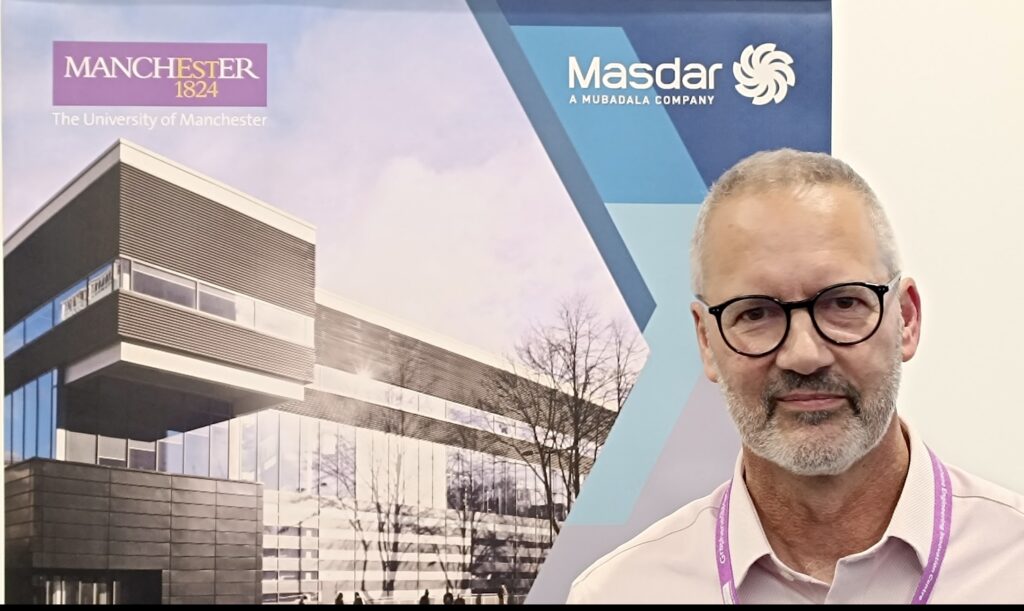
Professor James Baker

Professor James Baker, CEO of Graphene@Manchester, describes Manchester’s journey to commercialise the Nobel Prize-winning discovery of Graphene.

In this conversation, recorded at the University of Manchester Graphene Engineering and Innovation Centre, Professor Baker explains the steps Manchester (the City and the University, with support from central government and foreign investors) is taking to nurture startups, SMEs and established industries in developing a commercial ecosystem centred on the applications of Graphene. He describes the unique role of the UoM, the National Graphene Institute and the GEIC.

Some of the discussion points include

The following summary repeats the emphasis points you requested, condensing each into approximately a 10-word sentence, supported by comprehensive citations from the source material:

  • Graphene was isolated in Manchester in 2004, and its discovery won the Nobel Prize in Physics.
  • Manchester continues its history of innovation, fulfilling the “discovered in Britain” vision.
  • Extraordinary properties (e.g., 200 times stronger than steel) drive an industry “pull” philosophy.
  • Commercial applications include batteries, sensors, coatings, composites, and sustainable construction materials.
  • The National Graphene Institute (NGI) focuses on accelerating fundamental 2D material science with low Technology Readiness Level (TRL).
  • The GEIC is “industry-led but academic-fed,” accelerating high TRL commercialisation with know-how.
  • The Manchester Model (NGI/GEIC) helps companies navigate and accelerate through the “valley of death”.
  • The GEIC has fostered over 70 startups, many of which are now scaling up and opening factories.
https://media.blubrry.com/astrotalkuk_podcast_feed/astrotalkuk.org/wp-content/uploads/2025/10/Episode126_Graphene_JamesBaker.mp3

Podcast: Play in new window | Download (Duration: 1:11:52 — 58.7MB) | Embed

Subscribe: Apple Podcasts | Spotify | RSS | More
Share this:

  • Click to share on LinkedIn (Opens in new window) LinkedIn
  • Click to share on Facebook (Opens in new window) Facebook
  • Click to share on Bluesky (Opens in new window) Bluesky

Episode 125: Britian’s Greatest Pilot Captain Eric “Winkle” Brown

By Gurbir Dated: September 4, 2025 Leave a Comment

Captain Eric “Winkle” Brown. January 2011

You may have seen the BBC documentary Britain’s Greatest Pilot. Yes, he was an outstanding pilot, but there was much more to him than just that. I published extracts from an interview with Captain Eric Brown in April 2011. This extended version (over an hour) has not been published before .. until now.

In 2011 I visited Captain Eric Winkle Brown to record an interview on his one-to-one meeting with Yuri Gagarin on 13th July 1961 at the Admiralty in London. This was the day after Gagarin visited Manchester. After that discussion, the interview continued. Captain Brown spoke of his fond memories of a German WW1 pilot, Ernst Udet, who encouraged him to fly. During the war, he excelled as a test pilot and went on to become the chief test pilot at Farnborough.

After WW2, using his fluent German language skills, he interrogated Hermann Goering, Hanna Reitsch and Wernher von Braun. He spoke of a mission to Germany immediately after the war to acquire German aviation technology. Following a secret UK/USA deal, Britain passed its research on supersonic aviation to the USA and cancelled the Miles M.52 program. Had this deal not gone ahead, Eric Brown would have been the first to break the sound barrier in 1946; instead, Chuck Yeager claimed that record in 1947. He recalls that and many other stories in the interview recorded in his home in January 2011.

https://media.blubrry.com/astrotalkuk_podcast_feed/astrotalkuk.org/wp-content/uploads/2025/08/Episode125_BritainsGreatestPilot_EricBrown.mp3

Podcast: Play in new window | Download (Duration: 1:08:22 — 81.8MB) | Embed

Subscribe: Apple Podcasts | Spotify | RSS | More
Share this:

  • Click to share on LinkedIn (Opens in new window) LinkedIn
  • Click to share on Facebook (Opens in new window) Facebook
  • Click to share on Bluesky (Opens in new window) Bluesky

Episode 124: Exploring the Stellar Neighbourhood. The Toliman Space Telescope

By Gurbir Dated: June 25, 2025 Leave a Comment

Toliman Space Telescope. Credit Toliman.Space

Just as the Moon was the first stepping stone for our interplanetary exploration, our nearest star, the Alpha Centauri System, will inevitably become our stepping stone for our Interstellar Journey. That is in the distance. A new mission, The Toliman Space Telescope, is launching soon will target the Alpha-Centauri System from Earth orbit.

In summary

The Toliman mission is a fairly innovative space mission primarily designed to survey our stellar neighbourhood for Earth-equivalent planets. Its main research target is to point its telescope towards the Alpha Centauri system to search for planets, specifically hoping to find Earth-sized equivalents in the habitable zone around the two main stars, Alpha Centauri A and B.

Toliman is unique for several reasons. The 12 cm diameter telescope is the only scientific instrument built on a low-budget 16U CubeSat, using off-the-shelf components as much as possible and employing commercial ground stations.

It will use three unique innovations to attain high-precision measurements 1. a Diffractive Pupil Optical Mask 2. High-Precision Tip-Tilt System with fine-steering or fine-pointing the telescope to achieve the required 1-2 arcsecond pointing accuracy and reduce jitter. A novel AI-powered software, called dLux, running on a custom computer onboard the satellite, will preprocess data before it is downlinked.

It has multiple countries involved in development and partnership including the University of Sydney (Australia), Breakthrough Initiatives, University of Leiden (Netherlands), Carling Japan (Japan), SETI Institute (California, USA), Spar Blue (Australia), Leaf Space (Italy – ground stations), Durosad (Bulgaria and France – space bus), AOS (Connecticut, USA – telescope), Lights Optical (UK – secondary mirror), and a team member in New Zealand. Cooperation is also starting with JPL (USA).

During the Breakthrough Discuss conference in April in Oxford, I learnt a little about the Toliman Space Telescope.

https://media.blubrry.com/astrotalkuk_podcast_feed/astrotalkuk.org/wp-content/uploads/2025/05/Episode-124-Toliman-Space-Telescope.mp3

Podcast: Play in new window | Download (Duration: 1:07:08 — 55.5MB) | Embed

Subscribe: Apple Podcasts | Spotify | RSS | More

Share this:

  • Click to share on LinkedIn (Opens in new window) LinkedIn
  • Click to share on Facebook (Opens in new window) Facebook
  • Click to share on Bluesky (Opens in new window) Bluesky

Episode 123: Soaring over the surface of Titan: NASA’s Dragonfly Mission

By Gurbir Dated: May 29, 2025 Leave a Comment

Dr Elizabeth Turtle and a scale model of Dragonfly. Credit: NASA

It is December 2034. A spacecraft launched from Earth in July 2028, enters Titan’s atmosphere at 5km/s. Around 2 hours later, it softly lands on the surface at less than 1m /s. Over the next three years, NASA’s Dragonfly mission, a rotorcraft the size of a small car, will chemically analyse the Titan’s atmosphere, ground and a little of its subsurface.

In this interview recorded on 24th April 2025 in Oxford during Breakthrough Discuss, Dr Elizabeth Turtle, Principal Investigator, on the Dragonfly mission to Saturn’s largest mission – Titan.

Some of the topics Dr Turtle covers include

  • Dragonfly’s scientific objectives to explore complex organic chemistry and understand the steps that occurred before biology took hold on Earth, helping us learn about our own chemical origins.
  • Dragonfly isn’t just landing; it’s designed to fly from place to place. Over its nominal mission lifetime of a little over three years, it expects to visit 30-40 different landing sites.
  • Flying on Titan is actually easier than flying on Earth because its atmosphere is four times denser and its gravity is only one-seventh of Earth’s.
  • An overview of the Dragonfly – large rotorcraft, technically an X8 octacopter, roughly the size of a small car or the large Mars rovers like Curiosity and Perseverance.
  • Dragonfly is powered by an MMRTG, a Multi-Mission Radioisotope Thermoelectric Generator, which provides both the electricity and the crucial heat needed to keep the lander’s interior warm in Titan’s frigid environment.

With a launch set for July 2028 and arrival at Titan in December 2034, Dragonfly promises to reveal the detailed chemistry of this unique world. Launch dates are always susceptible to change. The Cassini-Huygens mission that arrived at Saturn/Titan in 2004 was launched in 1997. Saturn orbits the sun every 30 years. If Dragonfly misses the July 2028 launch window, there may be another thirty-year wait!

https://media.blubrry.com/astrotalkuk_podcast_feed/astrotalkuk.org/wp-content/uploads/2025/04/Episode122_Are-we-alone-and-Breakthrough-Initiatives.mp3

Podcast: Play in new window | Download (Duration: 46:42 — 44.4MB) | Embed

Subscribe: Apple Podcasts | Spotify | RSS | More

Share this:

  • Click to share on LinkedIn (Opens in new window) LinkedIn
  • Click to share on Facebook (Opens in new window) Facebook
  • Click to share on Bluesky (Opens in new window) Bluesky
« Previous Page
Next Page »

Find me online here

  • E-mail
  • Facebook
  • LinkedIn
  • Twitter
  • Vimeo
  • YouTube

subscribe to mailing list and newsletter

  • This field is for validation purposes and should be left unchanged.

Browse by category

Recent Comments

  • Frank Pleszak on Episode 117: Early Aviation in Manchester
  • Gurbir Singh on Episode 111: Chandrayaan-3
  • Lunar Polar Exploration Mission: Difference between revisions – भोजपुरी on Episode 82: Jaxa and International Collaboration with Professor Fujimoto Masaki
  • Gurbir on Public Event. Anglo Indian Stephen Smith – India’s forgotten Rocketeer
  • Sandip Kumar Chakrabarti on Public Event. Anglo Indian Stephen Smith – India’s forgotten Rocketeer

Archives

Select posts by topic

apollo astrobiology Astrophotography BIS Book Review Carl Sagan CCD China chines space Cloud Computing cnsa commercial Cosmology curiosity Education ESA Gagarin History India Infosec ISRO jaxa Jodrell Bank Mars Media Moon NASA podcast radio astronomy Rakesh Sharma rocket Rockets Roscosmos Science Science Fiction seti Solar System soviet space space spaceflight titan USSR video Vostok Yuri Gagarin

Copyright © 2008–2026 Gurbir Singh - AstrotalkUK Publications Log in