AstrotalkUK

Not for profit podcast. Astronomy, Deep Space Exploration and International Collaboration

  • Home
    • FAQ
    • Contact
    • About
    • Privacy Policy
  • Content
    • Podcast
    • All episodes
    • Book Review
    • Cyber Security
  • Events

Episode 131: Space Weather and the Physical Research Laboratory, Ahmedabad in India

By Gurbir Dated: January 26, 2026 Leave a Comment

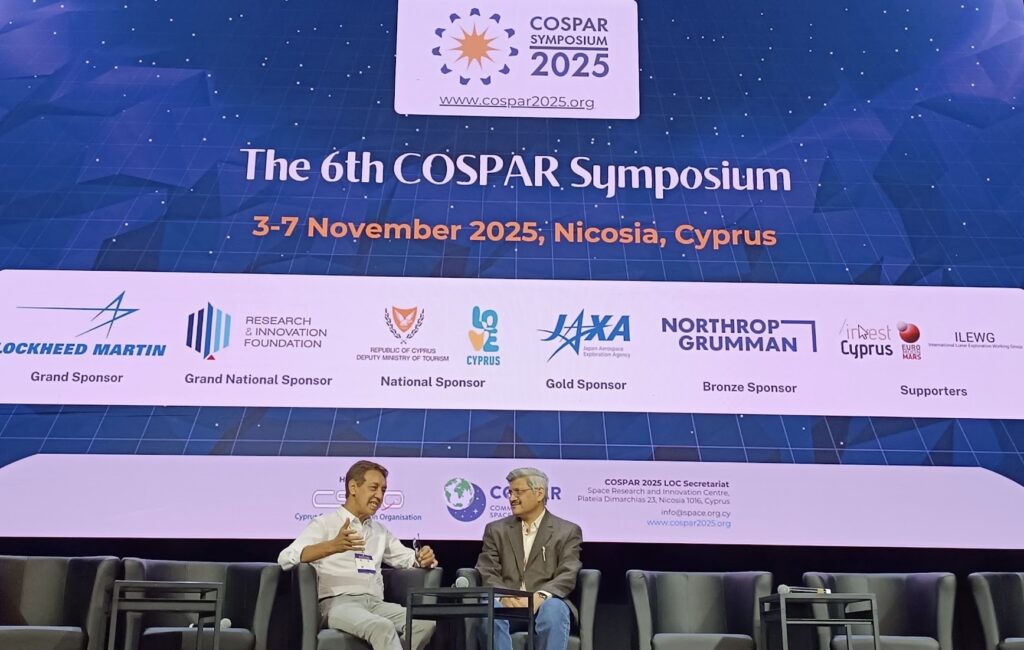
Professor Pallamraju at cospar2025.org

We are increasingly aware of the impact of space weather on spacecraft in space and, occasionally, on electrical power transmission on Earth, but what about its impact on the Earth’s atmosphere? That is exactly the research interest of Professor Pallam Raju, Dean of the Physical Research Laboratory in Ahmedabad, India. Founded in 1947, the PRL is one of India’s most prestigious scientific institutions, not least because it was founded by Dr Vikram Sarabhai.

In this conversation, recorded in Nicosia during COSPAR2025.ORG the topics we discussed include

  • Professor Pallam Raju’s transition from theoretical physics to experimental aeronomy (science of the upper atmosphere) was inspired by childhood curiosity about the sky and optics.
  • Professor Raju’s innovative optical instruments to detect faint atmospheric airglow and aurora against the overpowering glare of the sun.
  • His extensive fieldwork includes research in Antarctica, Greenland, and Norway, as well as the use of high-altitude balloons for ultraviolet measurements.
  • The impact of space weather involves solar particles hitting Earth, potentially damaging satellite electronics and disrupting vital global communications.
  • He describes how India participates in the 24/7 Global Oscillations Monitoring Group. including solar observatories at Mount Abu and Udiapur that help provide early warnings for satellite operators.
  • He describes space missions like Aditya L1 and the dual-satellite Disha project, which will comprehensively monitor solar-terrestrial interactions from space.

Share this:

  • Click to share on LinkedIn (Opens in new window) LinkedIn
  • Click to share on Facebook (Opens in new window) Facebook
  • Click to share on Bluesky (Opens in new window) Bluesky

Episode 110: Humanity’s spiritual destiny and the 100 year starship

By Gurbir Dated: November 10, 2023 Leave a Comment

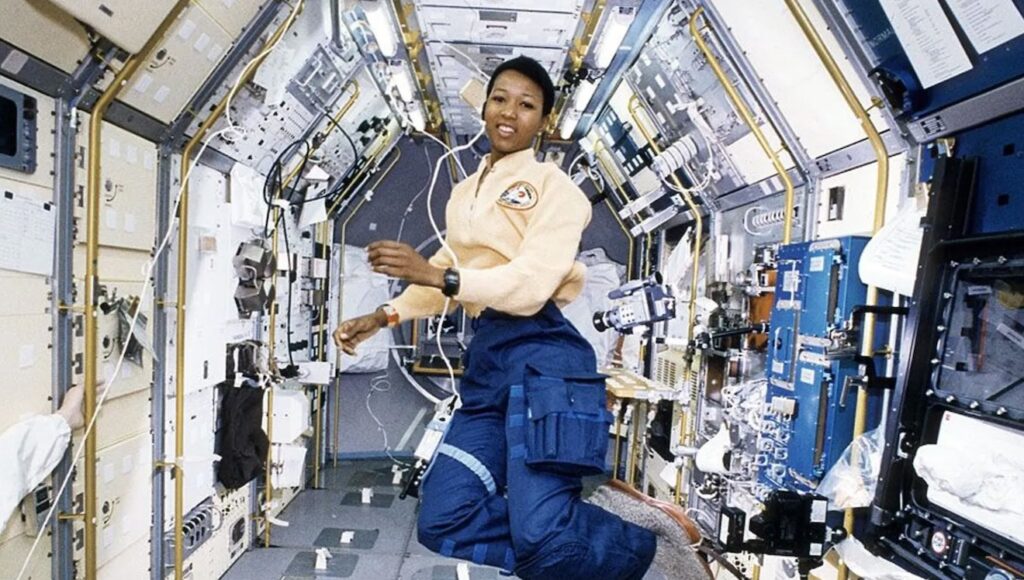
Nasa astronaut Dr Mae Jemison
Nasa astronaut Dr Mae Jemison. Credit NASA

NASA has dared and accomplished many “mighty things”. Not a NASA project but to reach the stars in 100 years is just as mighty.

The 100 year starship project aims to get humanity to travel to the stars in one hundred years time. It started in 2012, headed by Dr Mae Jemison, the first woman of colour to fly into space in STS 47 in 1992.

Jason Batt has several eclectic interests he is also the Creative and Editorial Manager for the www.100yss.org project. In a wide-ranging discussion in BAKU during the IAC2023, we discussed the role of science fiction, mysticism and spirituality in humanity’s distant future.

Listen (or watch if on YouTube) to the end for a clip of Dr Mae Jemison talking about the 100 Year Starship Manifesto. You can see it in its entirety here.

Audio and video for episode 110 below. Episode 25 has more on science and religion.

https://media.blubrry.com/astrotalkuk_podcast_feed/astrotalkuk.org/wp-content/uploads/2023/11/Episode110.mp3

Podcast: Play in new window | Download (Duration: 34:08 — 27.4MB) | Embed

Subscribe: Apple Podcasts | Spotify | RSS | More
Share this:

  • Click to share on LinkedIn (Opens in new window) LinkedIn
  • Click to share on Facebook (Opens in new window) Facebook
  • Click to share on Bluesky (Opens in new window) Bluesky

Episode 108: NASA’s Europa Clipper Mission

By Gurbir Dated: November 25, 2022 Leave a Comment

The Europa Clipper mission, due for launch in 2024, will arrive and orbit Jupiter in 2030. The third spacecraft to do so after Galileo (in 1995) and Juno (in 2016). The Pioneer and Voyager missions were flybys. The primary objective, as the mission name suggests, is the investigation of Jupiter’s Moon, Europa. Called Europa-Clipper after the 19th-century merchant ships that shuttled between ports at the high-speed then available.

Europa-Clipper will orbit Jupiter, not Europa. This is one of Jupiter’s moons that shows strong evidence of a sub-surface water ocean. During its four-year mission lifetime it will flyby Europa dozens of times looking for conditions suitable for life.

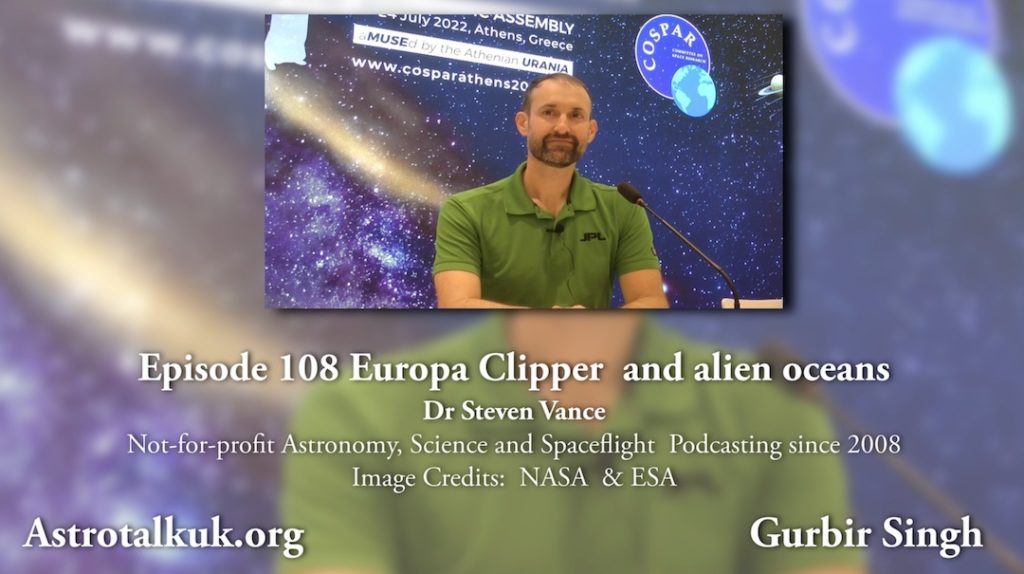
Dr Steven Vance talks about the mission’s goals and current state of readiness. This was recorded in Athens during Cospar 2022. He was the scientific advisor to the 2013 film Europa Report.


https://media.blubrry.com/astrotalkuk_podcast_feed/astrotalkuk.org/wp-content/uploads/2022/11/Episode-108-Steven-Vance.mp3

Podcast: Play in new window | Download (Duration: 25:49 — 29.7MB) | Embed

Subscribe: Apple Podcasts | Spotify | RSS | More
Share this:

  • Click to share on LinkedIn (Opens in new window) LinkedIn
  • Click to share on Facebook (Opens in new window) Facebook
  • Click to share on Bluesky (Opens in new window) Bluesky

Episode 106: ESA’s new science missions

By Gurbir Dated: November 11, 2022 Leave a Comment

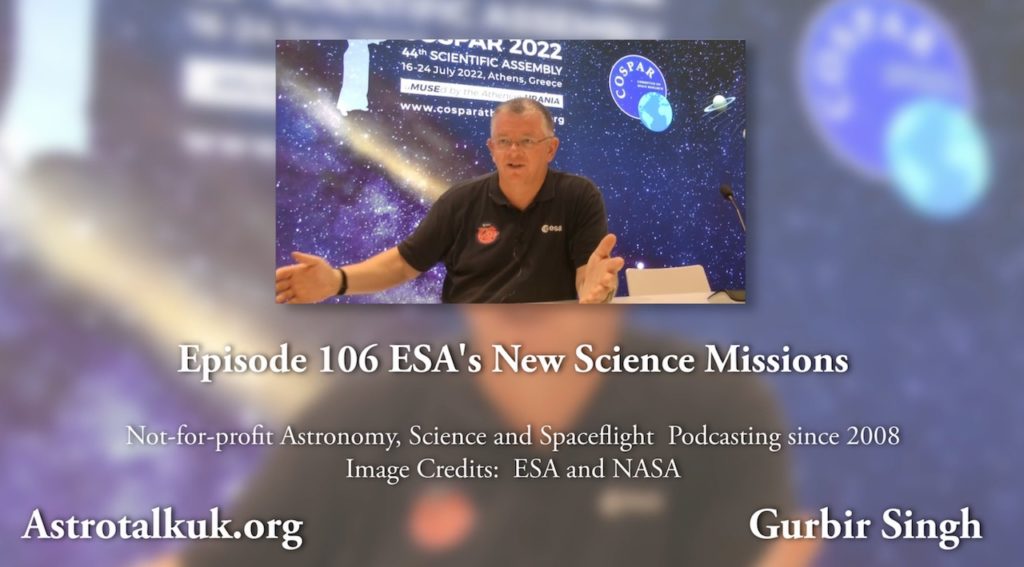
Pau McNamara

European Space Agency’s Dr Paul McNamara was studying low-frequency gravitational waves just before they were discovered in 2015. Now he is the astronomy and astrophysics coordinator for the European Space Agency. In this interview, recorded in Athens during Cospar2022, he speaks about some of the exciting science missions that ESA will be launching later this decade.

These missions include

  • Juice – JUpiter ICy moons Explorer
  • Euclid – To explore dark matter and dark energy
  • Plato – The next-generation planet-hunting mission
  • Ariel – A UK-led mission to explore the atmospheres of exoplanets

He also talks about ESA’s publicly available resources especially useful to science educators. Planetary Science Archive and ESA Sky. They are available to anyone, in or outside Europe and without charge. Links are available on this episode’s web page.


Dr Paul McNamara

https://media.blubrry.com/astrotalkuk_podcast_feed/astrotalkuk.org/wp-content/uploads/2022/11/Episode106.mp3

Podcast: Play in new window | Download (Duration: 43:00 — 98.4MB) | Embed

Subscribe: Apple Podcasts | Spotify | RSS | More
Share this:

  • Click to share on LinkedIn (Opens in new window) LinkedIn
  • Click to share on Facebook (Opens in new window) Facebook
  • Click to share on Bluesky (Opens in new window) Bluesky
Next Page »

Find me online here

  • E-mail
  • Facebook
  • LinkedIn
  • Twitter
  • Vimeo
  • YouTube

subscribe to mailing list and newsletter

  • This field is for validation purposes and should be left unchanged.

Browse by category

Recent Comments

  • Frank Pleszak on Episode 117: Early Aviation in Manchester
  • Gurbir Singh on Episode 111: Chandrayaan-3
  • Lunar Polar Exploration Mission: Difference between revisions – भोजपुरी on Episode 82: Jaxa and International Collaboration with Professor Fujimoto Masaki
  • Gurbir on Public Event. Anglo Indian Stephen Smith – India’s forgotten Rocketeer
  • Sandip Kumar Chakrabarti on Public Event. Anglo Indian Stephen Smith – India’s forgotten Rocketeer

Archives

Select posts by topic

apollo astrobiology Astrophotography BIS Book Review Carl Sagan CCD China chines space Cloud Computing cnsa commercial Cosmology curiosity Education ESA Gagarin History India Infosec ISRO jaxa Jodrell Bank Mars Media Moon NASA podcast radio astronomy Rakesh Sharma rocket Rockets Roscosmos Science Science Fiction seti Solar System soviet space space spaceflight titan USSR video Vostok Yuri Gagarin

Copyright © 2008–2026 Gurbir Singh - AstrotalkUK Publications Log in