AstrotalkUK

Not for profit podcast. Astronomy, Deep Space Exploration and International Collaboration

  • Home
    • FAQ
    • Contact
    • About
    • Privacy Policy
  • Content
    • Podcast
    • All episodes
    • Book Review
    • Cyber Security
  • Events

Episode 128: George Danos: Cyprus in Space

By Gurbir Dated: December 4, 2025 Leave a Comment

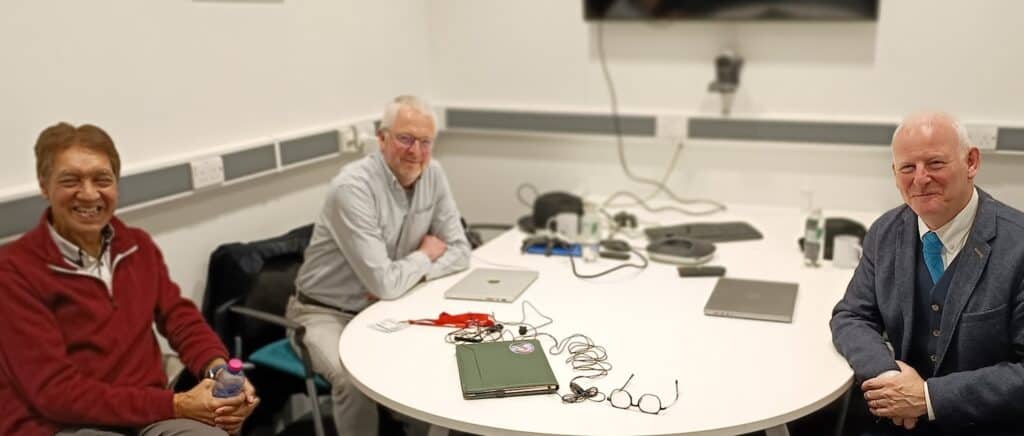
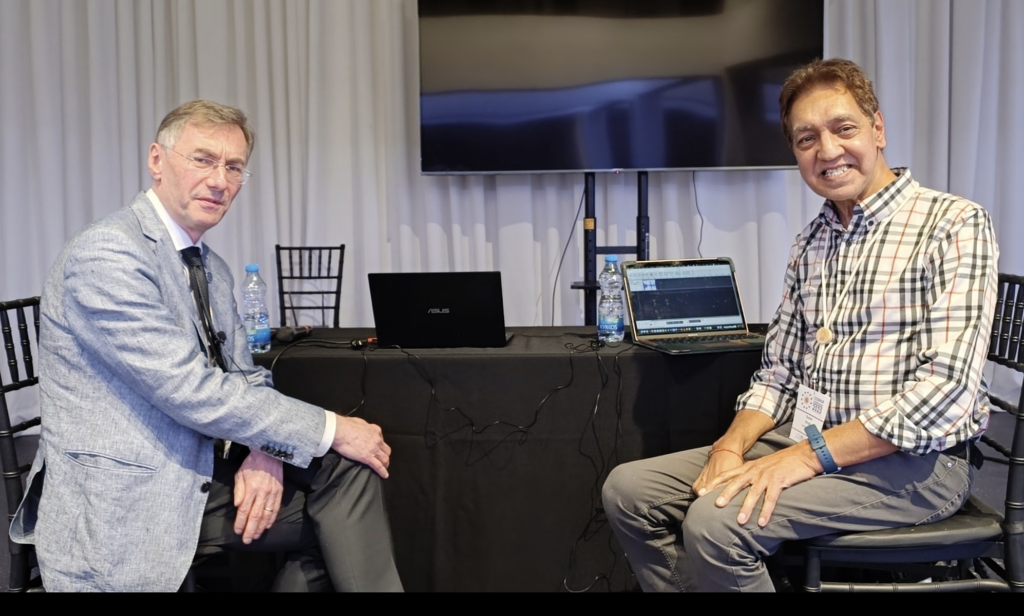
George Danos. President of CSEO

Cyprus is a small country with a small economy with big ambitions in space. George Danos is the president of the Cyprus Space Exploration  Organisation and is considered by some as Cyprus’s Carl Sagan. He has been championing the case for space in Cyprus for years.

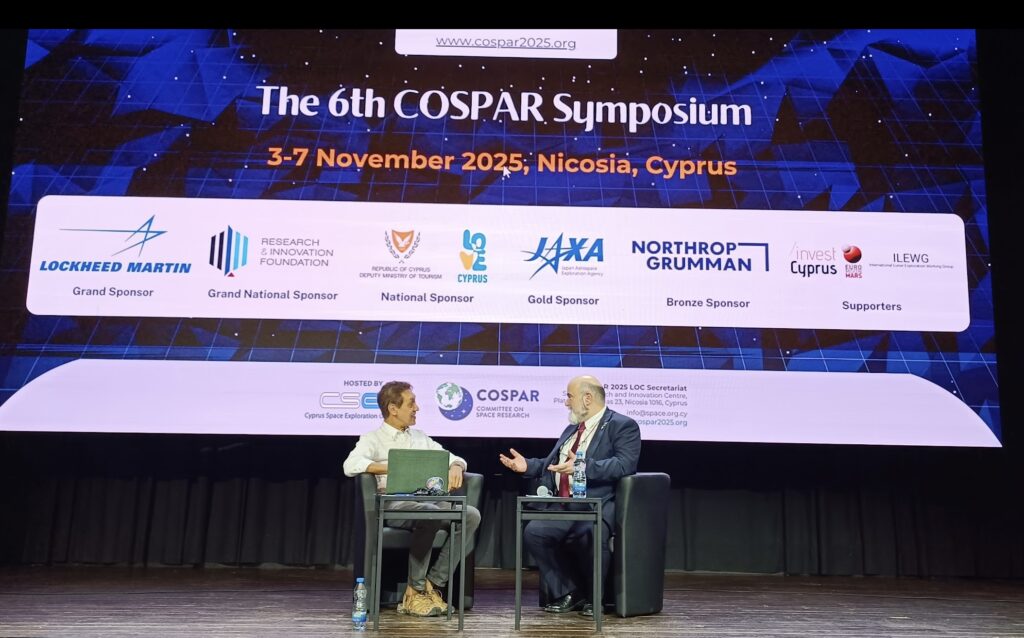
In this episode, recorded during Cospar 2025 in Nicosia, he describes the rise of Cyprus’s space activities in communication services, small satellites, collaboration with ESA and more.

  • As President of the Cyprus Space Exploration Organisation (CSO), George Danos has been pivotal in advancing Cyprus’s space programme, particularly regarding international partnerships, infrastructure development, and commercialisation.
  • CSO created spin-off companies, such as Space System Solutions, to promote technology transfer.
  • Cyprus recently achieved Associate Membership status within the European Space Agency (ESA).
  • George Danos spearheaded CSO’s major role in achieving the ESA PECs (Plan for European Cooperating States since around 2016.
  • Establishing the International Space Innovation Centre (CSpark) in Cyprus
  • The first fully integrated Cypriot CubeSat is targeted for readiness by 2026.
  • CSO signed an MOU with Japan’s IHI for new-generation secure maritime communication and India’s Pixxel space, focusing on hyperspectral Earth observation sensors.
https://media.blubrry.com/astrotalkuk_podcast_feed/astrotalkuk.org/wp-content/uploads/2025/12/Episode128_GeorgeDanos_CyprusInSpace.mp3

Podcast: Play in new window | Download (Duration: 48:50 — 40.8MB) | Embed

Subscribe: Apple Podcasts | Spotify | RSS | More
Share this:

  • Click to share on LinkedIn (Opens in new window) LinkedIn
  • Click to share on Facebook (Opens in new window) Facebook
  • Click to share on Bluesky (Opens in new window) Bluesky

Breakthrough Initiative – A Decade On

By Gurbir Dated: August 31, 2025 Leave a Comment

Pricipium Issue 50. August 2025

A version of this article was first published in August 20205 issue of Pricipium, the quarterly publication from the Initiative for Interstellar Studies. You can download the full issue here without charge.

The audio interview on which this piece is based (episode 122) is available for download here.


On 14 October 1959, a spacecraft, Luna 2, impacted the Lunar surface close to Mare Imbrium. It was launched by the USSR and arrived on the Moon two days after launch. It is the first object made on Earth to travel to the surface of another world. A decade later, spacecraft from Earth arrived on Venus and Mars. In the 21st century, spacecraft have arrived on the surface of Titan, asteroids, and even a comet. Five spacecraft have left or are on a trajectory to leave the solar system. In one lifetime, Interplanetary exploration has become almost routine. But where are we on our quest for interstellar exploration?

So far, exploration of the Solar system has been within the purview of national governments, predominantly the USA and the Russian Federation (formerly the USSR), as well as the European Space Agency and the Japanese Space Agency, in the case of Cassini-Huygens and Hayabusa. Interstellar exploration is many orders of magnitude more challenging. The immense challenges of interstellar exploration include vast distances, technological innovations, enormous timescales, and a novel funding source. Could the Starshot Initiative from the Breakthrough Foundation be the solution?

The Breakthrough Initiatives are the brainchild of physicist, entrepreneur, and investor Yuri Milner.

Breakthrough Starshot is a $100 million research and engineering program aimed at demonstrating the proof of concept for new technology, enabling ultra-light, uncrewed spaceflight at 20% of the speed of light and laying the foundations for a flyby mission to Alpha Centauri within a generation. The Starshot initiative, a proof-of-concept launched by Yuri Milner and Stephen Hawking in 2016, is funded by the foundation established by Yuri and Julia Milner.

Milner identified the discrepancy between the outstanding scientific question of our time, Life in the Universe. But he says, “On the bright side, that means it could offer considerable scientific return on investment”.

Initiated in 2012, the Breakthrough Prizes are a set of annual international awards in the fields of Mathematics, Life Sciences, and Fundamental Physics. The awards are part of the “Breakthrough initiatives” founded by Yuri Milner and his wife, Julia Milner. Laureates receive $3 million each in prize money (funded by Yuri and Julia Milner and others, including Sergey Brin and Mark Zuckerberg) during a televised award ceremony designed to celebrate their achievements and inspire the next generation of scientists. Breakthrough Prize was the first and is now joined by Breakthrough Listen, Breakthrough Watch, Breakthrough Message and Breakthrough Starshot.

Breakthrough Listen is targeting the 1,000,000 closest stars to Earth and is the largest-ever scientific research program seeking evidence of civilisations beyond Earth. The radio and optical surveys will cover a larger portion of the sky, deploy more instruments in multiple locations, have higher sensitivity, and utilise state-of-the-art digital signal processing and artificial intelligence tools.

Breakthrough Watch is a program to look for Earth-like planets within 20 light-years away, starting with the nearest Alpha Centauri system. If life exists on these planets with Earth-like characteristics (in terms of temperature, pressure, rocky surface, and potentially water), then the tell-tale signs of biosignatures and techno-signatures could make that breakthrough and detect the very first unambiguous signs of extraterrestrial life.

Breakthrough Message is an initiative designed to address the question: if the existence and the whereabouts of the first extraterrestrial intelligent civilisation is finally confirmed, what do we say to them? The content of the message is the primary focus, but so are the questions of who decides what form (language) the message will take, how it is constructed and who will send it. As the Apollo 8 astronauts recalled following their 1968 trip to the Moon, “We set out to explore the moon and instead discovered the Earth”. This is perhaps the most profound of all the initiatives, as it will allow us to learn about ourselves – even if no message is ever sent.

These initiatives can inform and complement one another. Results from Watch and/or Listen may direct Starshot and message.

Dr Pete Worden chairs the Breakthrough Discuss conferences and actively discusses the themes of all the Breakthrough initiatives, emphasising their interdisciplinary nature and focus on fundamental questions about life and intelligence. His interest in space and astronomy started as a boy when he asked his mother, “’Okay, what do people do that study stars?’ And she called them astronomers”.

Pete Worden had a long, distinguished career with a background in the military, specifically working with the Air Force, Space Command, missile defence, and being instrumental in the responsive space program during his active duty. He worked on arms reduction with the USSR during the Cold War.

In around 1982, long after the Apollo program, Pete Worden applied unsuccessfully to NASA’s astronaut program. During his time as the director of Ames Research Centre, he met Apollo 15 Command Module Pilot Al Worden. Both came from Michigan and were able to determine that Al Worden’s family was part of the extended Warden family in Michigan that had adopted Pete Worden’s grandfather.

In 2015, he left as head of NASA AMES Research Centre to become the chairman of the Breakthrough Foundation. In this role, he provides strategic leadership and oversight of the Breakthrough Initiatives suite. Reflecting on his 2015 meeting with Yuri Milner, he recalls, “he asked me to be the chairman of the overall farm foundation, not just the executive director of the initiatives, and so we’ve been at it about 10 years, and I think we’ve made major accomplishments”.

In his 2021 publication “Eureka Manifesto”, Yuri Milner asserts that “unlike organisations, businesses, companies or even nations, human civilisation can be seen as an entity that lacks a common mission. In the absence of that vision, humanity hinders its collective progress and, thus, in the end, its potential for long-term survival”. However, he does not simply assert his views as words on a page; by funding a series of apolitical, multidisciplinary, and international initiatives, he hopes to make progress on the most challenging questions of our time.

Reflecting on the big question at the root of all the initiatives, Worden says, “I think we’re going to find pretty strong evidence of life within a decade. Probably with our own solar system… so I think we’ll find life within a decade…. but I’m virtually certain we’re going to find life everywhere within a decade”. On the “whether we find evidence of intelligent life that’s .. who knows. You know, and again it depends on what we mean by intelligence..”

Share this:

  • Click to share on LinkedIn (Opens in new window) LinkedIn
  • Click to share on Facebook (Opens in new window) Facebook
  • Click to share on Bluesky (Opens in new window) Bluesky

Episode 124: Exploring the Stellar Neighbourhood. The Toliman Space Telescope

By Gurbir Dated: June 25, 2025 Leave a Comment

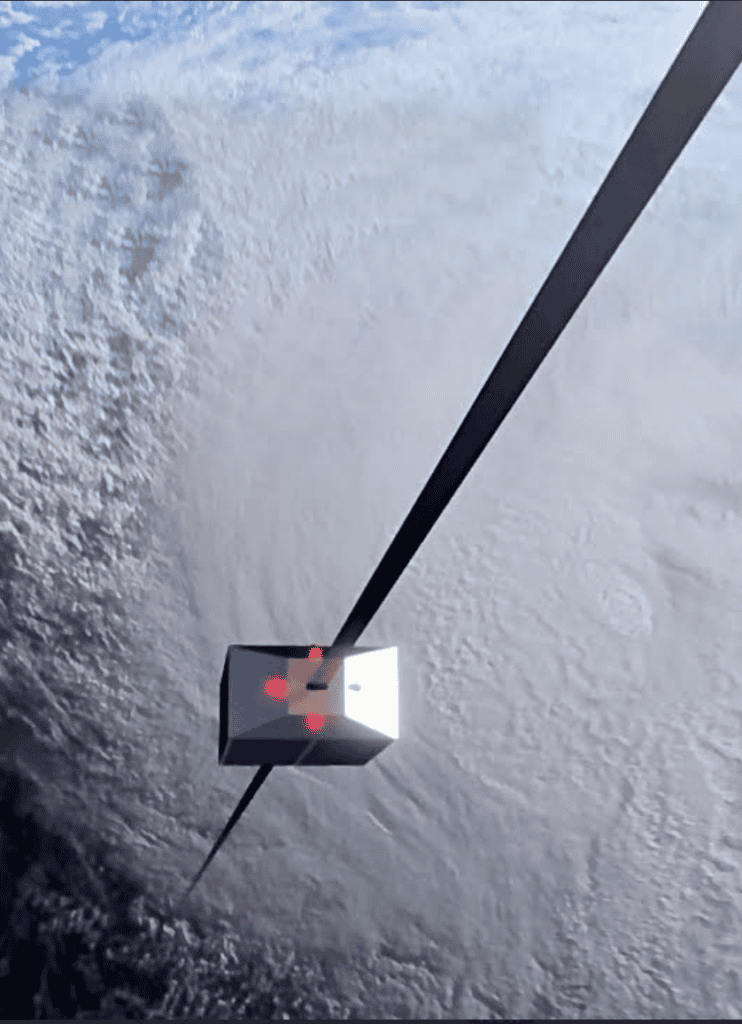
Toliman Space Telescope. Credit Toliman.Space

Just as the Moon was the first stepping stone for our interplanetary exploration, our nearest star, the Alpha Centauri System, will inevitably become our stepping stone for our Interstellar Journey. That is in the distance. A new mission, The Toliman Space Telescope, is launching soon will target the Alpha-Centauri System from Earth orbit.

In summary

The Toliman mission is a fairly innovative space mission primarily designed to survey our stellar neighbourhood for Earth-equivalent planets. Its main research target is to point its telescope towards the Alpha Centauri system to search for planets, specifically hoping to find Earth-sized equivalents in the habitable zone around the two main stars, Alpha Centauri A and B.

Toliman is unique for several reasons. The 12 cm diameter telescope is the only scientific instrument built on a low-budget 16U CubeSat, using off-the-shelf components as much as possible and employing commercial ground stations.

It will use three unique innovations to attain high-precision measurements 1. a Diffractive Pupil Optical Mask 2. High-Precision Tip-Tilt System with fine-steering or fine-pointing the telescope to achieve the required 1-2 arcsecond pointing accuracy and reduce jitter. A novel AI-powered software, called dLux, running on a custom computer onboard the satellite, will preprocess data before it is downlinked.

It has multiple countries involved in development and partnership including the University of Sydney (Australia), Breakthrough Initiatives, University of Leiden (Netherlands), Carling Japan (Japan), SETI Institute (California, USA), Spar Blue (Australia), Leaf Space (Italy – ground stations), Durosad (Bulgaria and France – space bus), AOS (Connecticut, USA – telescope), Lights Optical (UK – secondary mirror), and a team member in New Zealand. Cooperation is also starting with JPL (USA).

During the Breakthrough Discuss conference in April in Oxford, I learnt a little about the Toliman Space Telescope.

https://media.blubrry.com/astrotalkuk_podcast_feed/astrotalkuk.org/wp-content/uploads/2025/05/Episode-124-Toliman-Space-Telescope.mp3

Podcast: Play in new window | Download (Duration: 1:07:08 — 55.5MB) | Embed

Subscribe: Apple Podcasts | Spotify | RSS | More
Share this:

  • Click to share on LinkedIn (Opens in new window) LinkedIn
  • Click to share on Facebook (Opens in new window) Facebook
  • Click to share on Bluesky (Opens in new window) Bluesky

New Spacesuit from AxiomSpace

By Gurbir Dated: October 16, 2024 Leave a Comment

Private space companies produce a wide range of products and services for the developing space economy. Today, Axiomspace announced its Extravehicular Mobility Unit (AxEMU) or spacesuit here at IAC2024. This is the new generation of spacesuits for use on the lunar surface by NASA astronauts on the Artemis-iii mission.

Credit:Axiom Space

There are no “standout” major differences in appearance, but the development of technology since the 1960s will make these suits safer, longer lasting and more comfortable.Astronauts will return to the South Pole, an area not visited during the Apollo era, and there will be women, too. Some of the details that came out of the press conference and the Q&A that followed include

  • Apollo spacesuits were tailor-made. The new ones are modular and support men and women. The gloves are personalised.
  • Mitigation of the impact of lunar dust
  • Built-in nutrition.
  • The design incorporates the south pole conditions – lower temperature and the sun being mostly low in the sky.
  • Can accommodate operations for 8 hours
  • Builtin lights, HD cameras and cellular communication
  • automatic biometric monitoring

It is the product of a private company. Other companies and countries will be producing similar products. Although there is a recognition that international standards are required, none are currently established. At this early stage, the first spacesuit to attract widespread deployment will establish a foothold . That will most likely become the de facto standard.

Share this:

  • Click to share on LinkedIn (Opens in new window) LinkedIn
  • Click to share on Facebook (Opens in new window) Facebook
  • Click to share on Bluesky (Opens in new window) Bluesky
Next Page »

Find me online here

  • E-mail
  • Facebook
  • LinkedIn
  • Twitter
  • Vimeo
  • YouTube

subscribe to mailing list and newsletter

  • This field is for validation purposes and should be left unchanged.

Browse by category

Recent Comments

  • Frank Pleszak on Episode 117 – Early Aviation in Manchester
  • Gurbir Singh on Episode 111 – Chandrayaan-3
  • Lunar Polar Exploration Mission: Difference between revisions – भोजपुरी on Episode 82: Jaxa and International Collaboration with Professor Fujimoto Masaki
  • Gurbir on Public Event. Anglo Indian Stephen Smith – India’s forgotten Rocketeer
  • Sandip Kumar Chakrabarti on Public Event. Anglo Indian Stephen Smith – India’s forgotten Rocketeer

Archives

Select posts by topic

apollo astrobiology Astrophotography BIS Book Review Carl Sagan CCD China chines space Cloud Computing cnsa commercial Cosmology curiosity Education ESA Gagarin History India Infosec ISRO jaxa Jodrell Bank Mars Media Moon NASA podcast radio astronomy Rakesh Sharma rocket Rockets Roscosmos Science Science Fiction seti Solar System soviet space space spaceflight titan USSR video Vostok Yuri Gagarin

Copyright © 2008–2025 Gurbir Singh - AstrotalkUK Publications Log in