This is an article about completing online courses and exams for an amateur radio operator’s licence in the UK
Gurbir Singh (M0KSN)
An edited version of the article below first appeared in the March 2022 edition of Radio Society of Great Britain monthly magazine Radcom
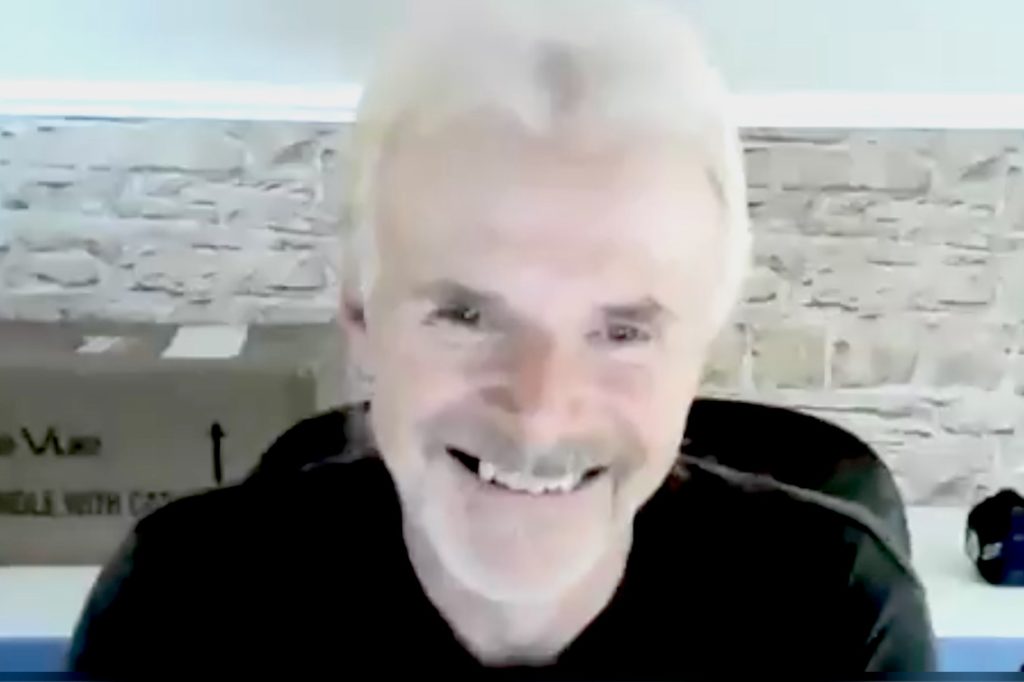
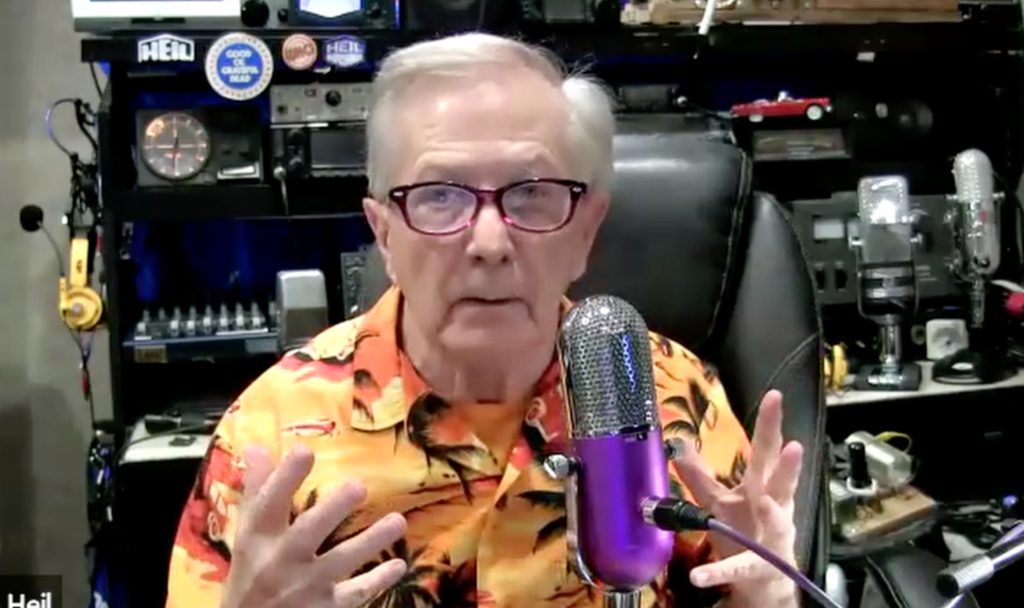
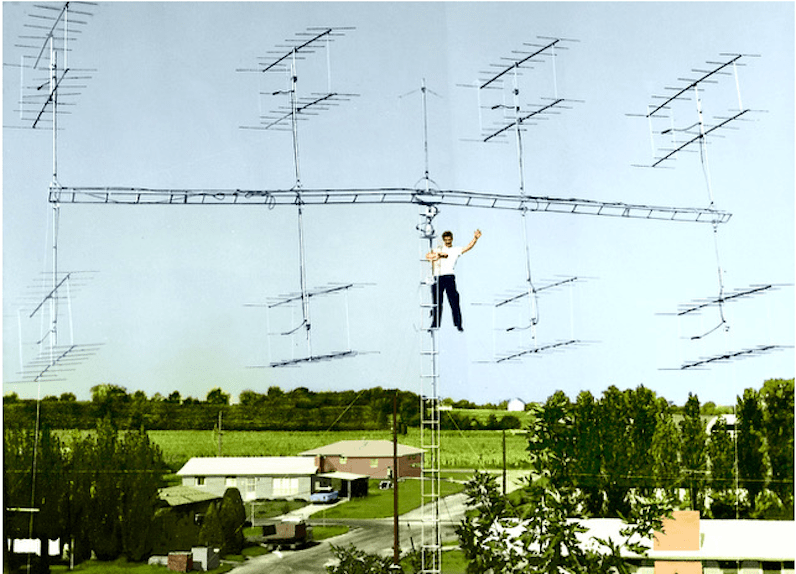
All images courtesy of Steve Hartley (G0FUW)
If you are one of 3000+ new entrants to the amateur radio hobby with Foundation Licence, there’s a good it was a chance consequence of the Covid-19 lockdown. That happened to me. I have now completed the Foundation, Intermediate and Full in around nine months. I share my experience below. Maybe it will help you with taking your next step.
The Covid-19 pandemic has been responsible for personal tragedies and suffering for millions of families around the world. The pain and distress are not yet over. It has also been an intellectually fascinating phenomenon to live through. Compelled to stay at home, many have used the time to learn a new skill or hobby. Some learnt to bake, learn another language or write a novel. For me, it was amateur radio.
By chance I saw a tweet from @amsatuk in July 2020 that pointed me to an online Foundation course with Essexham. The course involved 9 modules of online training over 4 weeks using the Schoology platform with a quiz after each module. With the traditional practical work suspended during the lockdown, the Essexham team given their “virtual training” pedigree made the Foundation course a real breeze. Each week had a recorded video supplemented with live webinars which were mostly Q&A. As a new entrant getting the Foundation licence was no cake-walk but not a major hurdle either.
I completed my Intermediate and full courses in 2021 with the Bath Based Distance Learning program organised by Bath and District Amateur radio Club.
Bath Based Distance Learning
In November 2020 I came across the online Intermediate course from Bath Based Distance Learning or BBDL. After the first two weeks, I was very suspicious, confused and incredulous. The BBDL course structure for Intermediate (and pretty much the same for Full) involved watching a live two-hour weekly tutorial on Zoom or a recording of it; a weekly routine of directed study to review progress and revise weak spots, read additional text, watch supplementary videos, complete practical exercise (using an electronic kit of transistors, LEDs, Resistors, Capacitors and a small breadboard (there were no practical sessions for the Full course) and complete the weekly quiz. Each quiz question with an average correct score of 50% or less was reviewed in detail at the beginning of the next live weekly tutorial. How much did I have to pay for all this? Zilch.
Once you submitted your quiz (online using the Edmodo platform), your personal tutor reviewed the quiz and provided personalised feedback along with worked answers (a pdf). The answers to the maths questions not only contained the numerical answer but the long sequence of keys to press on the calculator to get it. An interesting incentive, only those who submitted their quiz received the worked answers. These worked answers served as a critical marker on progress and also an essential asset when preparing for the exam.
In addition to the weekly quiz, every three weeks there was an additional one, so two quizzes that week. The usual weekly quiz and another consolidating the material of the previous three weeks. This was a useful progress check. So by the time, it came to the exam, we would have a pretty good idea of how much preparation was needed and where it should be targeted. Two mock exams aligned to the structure of the actual exam along with Radio Society of Great Britain (RSGB) mock exams with supplemental live zoom session was essential for me getting through the exam.
Spirit of the Hobby
So why was I suspicious at the outset? I have worked in the private sector and attended professional courses paid for by me or by my employer. Typically, they would cost several £100 per day, in addition to accommodation and exam fees. In another life, I have prepared and delivered courses online. I know it takes ages to do really good ones and can’t be done on the cheap. Here’s the thing, the BBDL (and EssexHam) courses were free. The Intermediate and especially Full are demanding courses. They are intense in the quantity and complexity of the content. The BBDL courses were well organised, professionally prepared and obviously the end product of enormous time and effort.
Despite this professionally prepared content with a high level of expert insights and personalised support, I had to pay nothing. I could not stop thinking of the adage, “if it sounds too good to be true, then it’s not”. I could not see the catch. There had to be one. To make courses like this work, you need dedicated experienced people, access to resources and a well-oiled ecosystem that can accommodate 40+ (Intermediate) and then 100+ students for the Full. It took a few weeks before I figured it out. I’m slow like that.
The “catch” was all to do with the word amateur and its French root the “love of something”. The word has its negative connotations sure but in Amateur Radio clubs and societies in Britain and beyond are embedded in the culture of sharing, non-profit and the spirit of selflessness. I had seen it in the amateur astronomy world in which I have participated for decades. My own decade-old not-for-profit blog (astrotakuk.org) is founded on it. It has no trackers, adverts or subscriptions. It took a while for me to see it but the Amateur Radio community was rooted in that spirit. An essential and resilient attribute of a century-old community. A community where a simple but sincere “thank you” when donating blood or devoting a few hours in the voluntary sector is incredibly more satisfying because it is not paid.
I joined the Amateur radio community less than a year ago so my conclusions here are based on limited experience. One of the first was just after I acquired my Foundation licence and joined the local group Rochdale and District Amateur Radio Society (RADARS). I had a Baofeng handset and Rob (M0NVQ) travelled 5 miles to meet at a local elevated site. With his help, I made my first QSO. He travelled 5 miles just to meet me – a total stranger. Some of the amateur radio equipment (rigs and handsets) can be really expensive but all the essential elements on the road to the hobby are without charge or very little. The official Full course book costs just over £10, the exam fee of £37.50 and no charge for the licence itself. Just as with online training, online examinations have been supported by unpaid volunteers. Given the technical challenge of invigilating three (in my case) candidates simultaneously each with two cameras and no doubt a Testreach console, the invigilator did not appear overwhelming. In the spirit of the hobby, they were unpaid too. For me, they were Martin (G3ZAY), Ann (G8NVI) and Andy (G4HUE).
To get so many “new entrants” to engage through the Intermediate and Full examinations is no trivial task. How was it that BBDL pulled this remarkable feat? In short, it was down to the BBDL team’s sincere commitment to the “amateur” spirit of the hobby, developing a student-centred structured program focused on the syllabus and guided by an experienced and dedicated team of tutors.
The “too good to be true” bit, the catch I was looking for was the time I had to devote to get through the course and the exam. The BBDL course required that I pulled up my sleeves and got stuck in. There is no easy option. I had to put in the hours. I am not particularly bright so am used to the hard grind. The structure and administration of the course ensure all the resources (weekly instructions, presentation slides and video, quizzes with worked answers and regular tutor support) are at a known location and always accessible. Everything needed to succeed is present but only if students do their bit (or a lot as in my case but depends on the individual’s starting point). The typical student commitment is about 4 to 6 hours a week. In the days leading up to the exam, I had put in those hours daily.
Preparation, Planning and Teamwork
Reflecting on the reasons why the BBDL Intermediate and Full courses were so successful, it’s probably down to three reasons. First, it was a team of tutors with the extensive requisite technical hands-on experience and collaborative work ethic that put the student at the centre. Secondly, a planned and organised structure and format. The format for each week’s activity was the same and captured in the weekly instructions document. It summarised key points of the topic including coursebook page numbers and syllabus references. It also pointed to the additional (to the live or recorded weekly session) videos to watch, texts to read and to prepare for the weekly quiz.
The third, although the least tangible is the most important. The learning environment, albeit online, is infused with culture, values and ethics of an amateur hobby. All the interactions between the tutors and students throughout the duration of the course were professional and sensitive to the diverse range of skills and experiences of the students. More than anything else that spirit of welcoming and sharing that is at the heart of the amateur radio hobby is epitomised in the BBDL experience.
A BBDL team consist of 16 tutors with a core team of three. Fronted by Steve Hartley (G0FUW), Mike Bowerman (M0MVC) and Lewis Thomas (G4YTN). Steve has almost 40 years of hands-on amateur radio experience and teaching for 30 years. His insights as an author, member of the RSGB Training & Education Committee and detailed understanding of the syllabus, ticks pretty much all the boxes to drive these training courses.
In the Full course (March 2021) 220 applied, 140 enrolled of those 90 have committed to sitting the exam. Currently (mid-July) 70 of those 90 have passed, a pass rate of 93%. That is an astonishing number and the end product of numerous hours dedicated to producing the material, teaching the course and fielding queries. How many hours does the BBD team take in preparing the course? Steve says “it is impossible to say. It is far from being a full-time job, but it could become one if you let it”. BBDL plan to run a further Full course from August to December 2021, Intermediate between January and April 2022 and another Full after that. Want to try it yourself? The following gives you an idea of what is involved.
Course Content
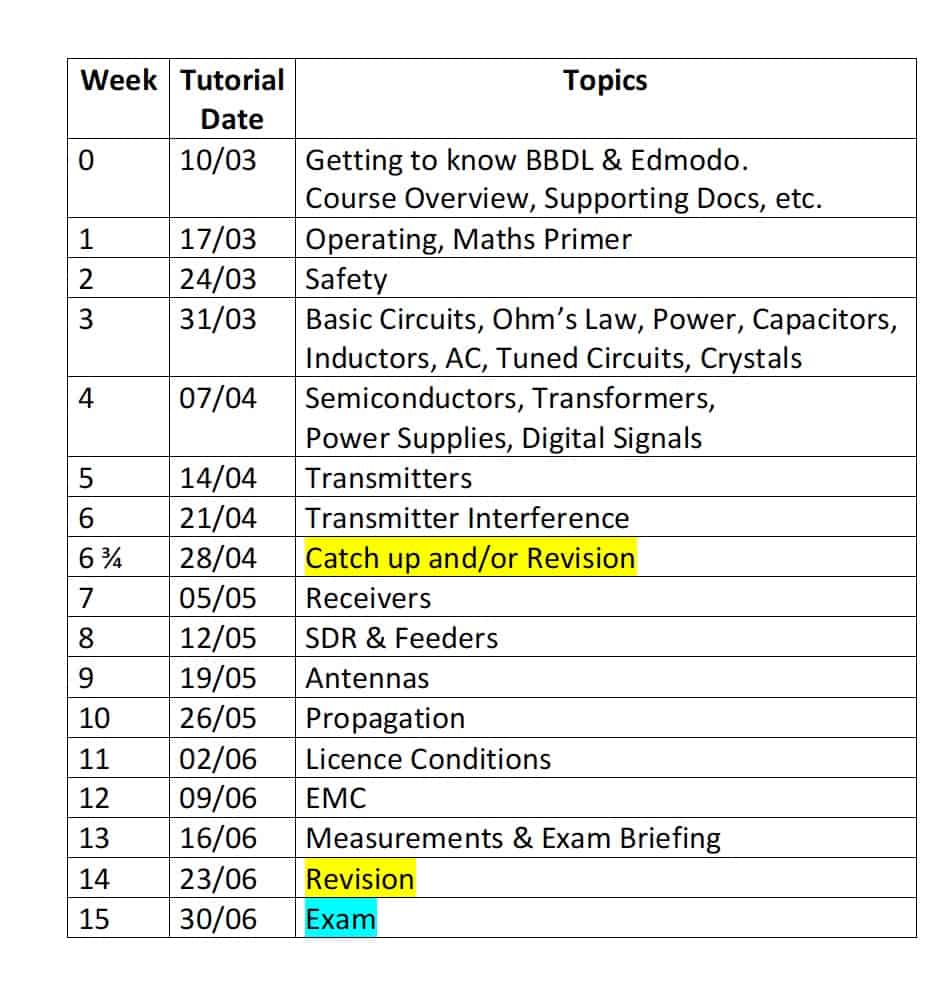
Most of what follows is based on the BBDL Full course but in principle applies to Intermediate and other providers too. Prior to joining the course, the weekly demands of around 4 hours minimum is made clear. A pre-course activity also helps students to decide if the course is suitable. Typically, the course runs over 16 weeks (including 3 weeks for catchup, revision and exam prep) and each week consists of:
- A live two-hour zoom session (video)
- Weekly instructions (a document – outlining sections in the textbook to read, additional videos to watch and potential practical exercise)
- Weekly quiz based on the week’s topic. Online via Edmodo.
- Every three weeks there is an additional quiz designed to assess progress of all the material to date. Online via Edmodo.
- Additional resources include – videos and text are made available focusing on specific topics including oscillators, amplifiers, risk assessment, basic transistor configuration and peak to RMS conversion. Maths primers to learning about logs, engineering notation and key-by-key guide on how to perform some common calculations using the recommended calculator type.
- Once the syllabus is covered two BBDL generated mock exams help prepare for the final exam. This is in addition to the two mock exams from RSGB.
Additionally, BBDL shared videos recorded over the years covering (working with calculators, tuned circuits, soldering, measuring AC voltages) were particularly useful during lockdown. It was interesting how BBDL dealt with the mathematical components of the Full course. It is mandatory and cannot be bypassed. In any cohort there are those who are put off by it. In addition to written primers for math, videos showing how to use the recommended calculator, Steve demonstrated during live sessions the step-by-step process of completing a calculation using an on-screen calculator. Many of the slides and quizzes included worked answers included the key-by-key steps to use on the calculator.
Syllabus Driven
Of particular interest to me was Steve’s persistent focus on the syllabus. He did not just present the syllabus but analysed and interpreted it. Why were the topics there? What questions could they lead to in the exam? Has this topic in the Full already been covered in the Intermediate? He would also assess and comment on the treatment of some syllabus topics as covered in the course book and providing additional resources or direction where required.
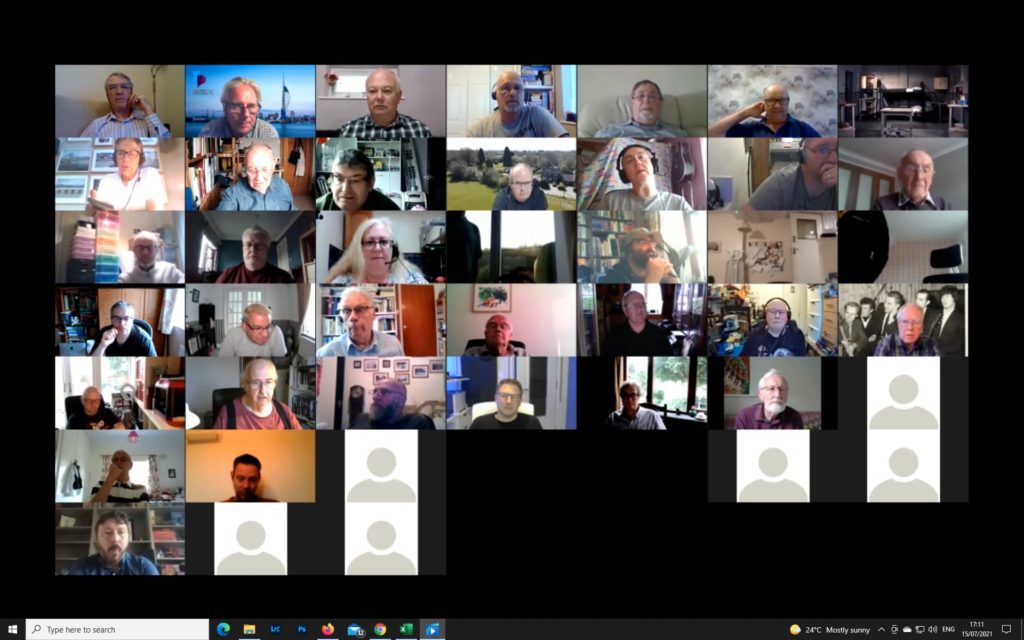
The collaborative approach between the tutors provided its own synergy, especially during the live Zoom sessions. They shared personal experiences of tackling EMC problem, dealing with Protective Multiple Earth and Dave (M0VTG) frequently used to reach in to a draw and pull devices under discussion (a moving coil meter, Virtual Network Analyser, home made a balun). This was particularly useful to those like me – very new to the hobby.
The Intermediate and the Full courses cover a range of complex concepts and phenomenon. Whilst everyone may have come across some, it is unlikely anyone will be familiar with all. So the focus on the process and technique of study remained a priority from the outset. The course plan included a revision week, regular quizzes, review of difficult topics with the personal tutor, encouragement to use variety of learning techniques – mind maps, flashcards and reviewing additional material from other tutors, RSGB or other sources. One student developed and shared a block diagram which could be printed, cut-out, flipped over and rearranged to practice putting all the blocks in the right sequence. Others shared flashcards, online resources for like books, videos and simulations.
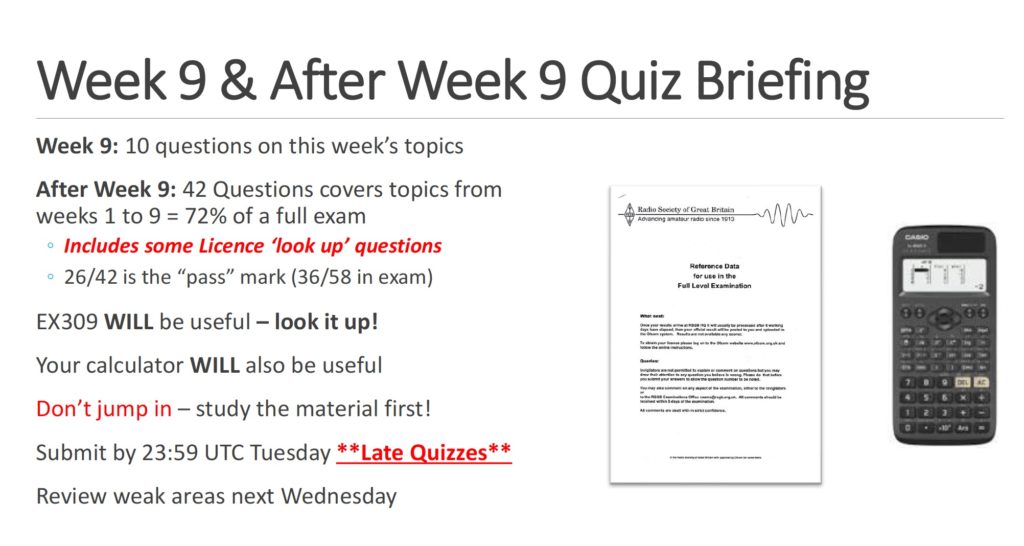
Two persistent themes ran through the course. Regular reminder to not to jump in and take the quiz on Friday when it was released but put the effort in preparing for it first. The repetitive but essential reminder to use the EX309 “Look it up – even if you think you know”. Surprisingly easy to overlook this and loose otherwise easy marks during the exam. Learning how to learn and sit exams was another important theme that ran through the course. Some of the many tips shared included:
- Sweep through all the questions in the first hour. Answer those you feel comfortable with. Mark and return to the others in the second hour.
- EX309 must be “clean” at start of exam. Spend first few minutes after exam start to add notes and label equations.
- Best Answer questions. All answers will be correct. Look for which is “more best under most situations”. Use the fixed exam structure as a guide (i.e. First 7 questions are always on Licence Conditions and the final 5 on Measurement and Construction.
- Don’t be a politician and answer your own question! Read the question more than once. As with the above, use the location of the question within the sequence of 1 to 58 to help identify what the syllabus topic the question is getting at and respond to that.
- If transposing equations does not come easy, don’t do it. Instead, work backwards. One of the 4 answers is correct. Repeat the calculation four time using the equation you know. Only one will be correct.
- The concept of a “sanity check”, will apply in some cases. A memorable tips can quickly help narrow down options for the correct answer. E.g. when calculating the total impedance in an AC circuit that contains resistance and capacitance, you cannot simply add the two. Z will always be more than either R or X but less than R+X.
- Look at all 4 answers before choosing. The first or second may look obviously correct but the correct answer may be the third or fourth.
- Not sure how to determine the right answer. Decide which one you can exclude and take a punt from those that remain.
- Do not leave any question unanswered. As a last resort – take a guess. You have 25% chance of a mark!
Conclusion
I am sure BBDL is not unique but in my limited experience it is. I heard good things about Bredhurst Receiving and Transmitting Society along with Cornish Radio Amateur Club. The number who pass unfortunately remains the primary measure of success. BBDL has done exceptionally well but even if you don’t pass – this is a fabulous learning experience.
In one of the live sessions I remember Steve talking about valves in modern radios. I was convinced he mis-spoke and would correct himself. I had no idea the valves were still in use in radios today. In another instance he slipped up again (I thought) when he said that a yagi antenna was a dipole. One antenna type I was familiar with – on the tops of roof of most house was a yagi. That a yagi was a specific implementation of a dipole was a revelation. I had heard of Decibels but never knew that it was a unit of power named after the inventor of the telephone Alexander Graham Bell. One tenth of a Bel, a Decibel or 1dB is the smallest increase of sound that the human ear can discern. If you are as old as me, I repeat “1dB IS THE SMALLEST INCREASE OF SOUND THAT THE HUMAN EAR CAN DISCERN”.
The pandemic has had a devastating impact on global society which has yet to run its course. One of the few upsides has been the boost in the Amateur Radio community worldwide. In addition to the boost in RSGB membership, I wondered how the hobby developing over the medium and long-term future. I wanted to record a podcast with the RSGB President Stewart Bryant, it did not work out, but my invitation is still there. I wanted to ask him about the RSGB’s role during the pandemic, the national impact of the Get on the Air to Care campaign and the influence on the RSGB of the sharp increase in membership.
During a private session with my tutor Ron (G4MRQ), he said something very simple that made everything drop into place. I was struggled with the concept of reactance. When talking about impedance matching he said an AMU contains capacitors and inductors. By tweaking their values all the reactance can be removed leaving only a resistive load. As a newcomer to the topic, it can take a few attempts before the penny drops. This was one memorable instance.
Interestingly Ron went on to say something else that was for me, profound. He taught me something that he probably had not intended. He said on more than one occasion, that he was “not a trained teacher” at the very moment he was doing just that. He had all the knowledge and experience and was communicating it effectively. What had he taught me unintentionally? I now have a Full licence but don’t feel I deserve it. Maybe I should.
It is not the destination but the journey. What a lovely journey it has been which I can now continue on air that will take me beyond Essex and Bath.
To download a pdf version of this post – click here